
Physicist Albert Einstein once said, “The important thing is not to stop questioning.” That idea holds true for businesses, too.
If you don’t ask questions, you won’t understand your customers, your employees, or your market.
Questionnaires are an effective way to gather feedback, empowering companies to understand behavior, measure sentiment, and make evidence-based decisions at scale.
Let’s break down the advantages and disadvantages of questionnaires so you can use them effectively.
TLDR
Questionnaires are a cost-effective, scalable, and time-saving way to collect feedback. They offer standardized data, flexible question types, and encourage honest responses. However, they can be misinterpreted, skipped, hard to analyze (especially open-ended answers), lack emotional insight, face accessibility issues, and may cause respondent fatigue. Clear, concise design and smart survey features help maximize benefits and minimize drawbacks.
To learn more about how online surveys work today, you can read our guide on What is an Online Survey?
What are Questionnaires?
A questionnaire is a research tool that contains a series of questions or prompts to gather information from respondents. They can be delivered as online questionnaires or paper forms, but the most common today are web-based surveys created with online survey tools.
By efficiently collecting qualitative data, quantitative data, demographic information, and opinions, questionnaires help organizations understand customers, improve product/service quality, and enhance the overall user experience.
What are the Types of Questionnaires?
Structured Questionnaires
A structured questionnaire uses fixed, predefined questions with set answer options like multiple-choice, rating scales, or yes/no questions. Everyone gets the same questions in the same order, which makes the data easy to compare, analyze, and quantify.
Semi-Structured Questionnaires
A semi-structured questionnaire blends fixed questions with open-ended ones. It provides consistency while still giving room for deeper explanations, making it a flexible option for many research studies.
Unstructured Questionnaires
An unstructured questionnaire uses open-ended questions that let people answer in their own words. Instead of selecting from options, respondents freely explain their thoughts, experiences, and opinions, giving richer and more detailed insights.
To explore when to use open-ended or closed-ended questions, check out Open-Ended vs Closed-Ended Questions: Strategies and Examples.
What are the Advantages of Questionnaires?
Below are the key advantages that make questionnaires a powerful and efficient research method:
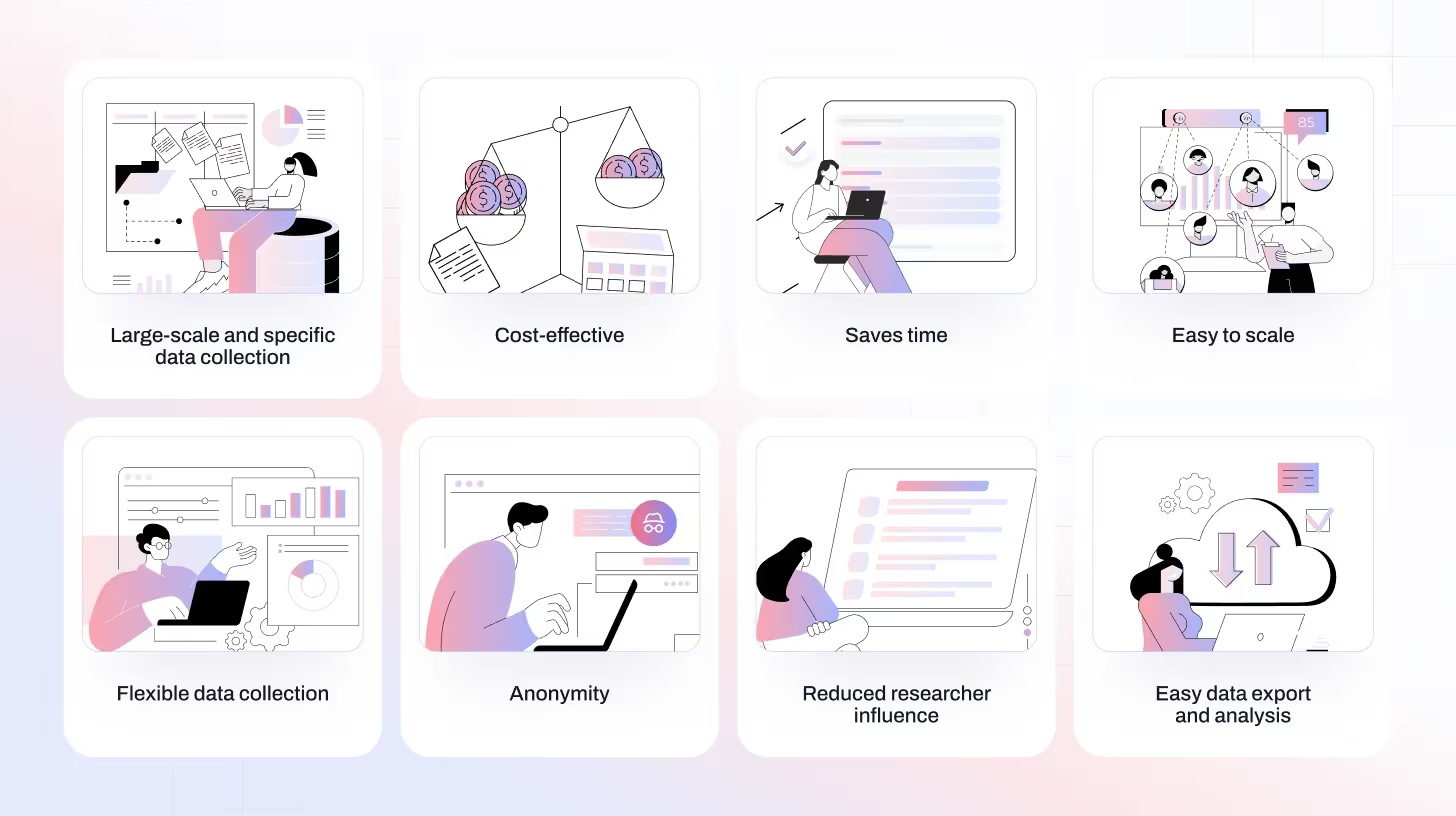
Large-Scale and Specific Data Collection
Research teams use questionnaires to collect focused, straightforward data. They’re especially useful for reaching a large audience. You can share them via email, websites, or online survey tools and gather responses from your audience across different locations. The advantage is that you get a clear, big-picture view of your audience without spending countless hours on one-on-one interviews.
Cost-Effective
Sending online questionnaires is an easy way to gather feedback without spending much. Unlike focus groups or in-person interviews, you don’t need to worry about travel, venue costs, or extra staff. It’s a smart choice if you want insights without breaking the budget.
Saves Time
Questionnaires are quick to create and distribute. With online tools and ready-made templates, setting up a professional survey takes minimal effort.
Recommended Read: How to Create an AI-Powered Survey in Minutes with TheySaid
Easy to Scale
In questionnaire research, one major benefit is scalability. You can gather responses from large groups without adding extra effort. No matter how wide your audience is, questionnaires make broad data collection simple and efficient.
Flexible Data Collection
Questionnaires can capture many types of information. By mixing multiple-choice and open-ended questions, you can collect both measurable data and deeper insights, giving you a well-rounded foundation for analysis.
Anonymity
Respondents often feel more comfortable being honest when their answers are anonymous. This leads to more accurate and candid feedback, whether it's a satisfaction survey, a quick pulse check, or any other type of research study.
Reduced Researcher Influence
Unlike interviews, where tone, wording, or body language can sway responses, questionnaires minimize researcher bias. Respondents answer independently, leading to more objective, reliable results.
Easy Data Export and Analysis
Most online questionnaire tools allow automatic exporting to spreadsheets or dashboards. This simplifies analysis and cuts down hours of manual work.
Read: How Do You Analyze Survey Data Like a Pro?
What are the Disadvantages of Questionnaires?
While the advantages of questionnaires are significant, it’s equally important to understand the disadvantages of questionnaires to avoid data quality issues.
Words Aren’t Always Interpreted the Same Way
A single question can mean very different things to different people. Imagine asking, “Was our service convenient?” Some respondents might think about location, others about speed, and some others might even consider pricing. That ambiguity can skew your results, leaving you scratching your head later. The trick is to keep language straightforward; sometimes, even giving a small example within the question helps.
Recommended Read: Leading and Loaded Questions: The Survey Killers (And How to Fix Them)
People Skip Questions
It happens. Respondents may dodge questions that feel too personal, confusing, or irrelevant. A mobile fitness app once asked users about their daily diet habits and found most skipped those sections entirely. It didn’t ruin the survey, but it left gaps in the insights they were hoping to gather. Making certain questions optional or framing them more gently can preserve your data.
Open-Ended Responses Can Be a Nightmare to Analyze
There’s nothing better for rich insight than a free-text answer until you have hundreds or thousands of them. A travel company asking about favorite destinations faced an overwhelming pile of responses. Sorting through it manually felt like digging for treasure without a map. A more innovative approach is to mix structured and open-ended questions, or to use tools to analyze text.
Emotions Often Get Lost
Questionnaires rarely capture the subtlety of human emotion. A hotel chain asked guests to rate staff interactions on a scale, but the ratings didn’t reflect frustration with long wait times. Adding rating scales with gradations or follow-up prompts can help, but it’s still not the same as seeing a frown or hearing a tone of voice.
Survey Fatigue is Real
Respondents can experience fatigue in two ways: before starting your survey, when they’re already tired of filling out similar forms; or during your survey, when it’s too long, repetitive, or seemingly irrelevant. Shorter surveys, clear explanations of why their input matters, and features like skipping irrelevant sections can make all the difference.
Read: 17 Best Survey Design Best Practices for Reliable Research Results
Rushed or Thoughtless Answers
Sometimes people just click through surveys without much thought. Whether it’s to finish faster or because they’re multitasking, these low-effort responses can distort your results. Including subtle engagement checks, like varying question types or asking for short explanations occasionally, can reduce this problem.

Research shows that longer questionnaires can significantly reduce response rates. In one trial, a 24-page postal questionnaire had almost 50% lower return rates than a shorter 15-page version (BMC Medical Research Methodology).
Another study found that surveys with 30–45 minutes estimated completion time had a 17.1% response rate, compared to 24.5% for shorter 15–30 minute versions. (PMC).
Once you understand the advantages and disadvantages of questionnaires, you can use smarter tools like TheySaid to overcome common challenges. Read below to see how TheySaid simplifies the entire process and makes your insights more accurate and actionable:
How TheySaid Helps You Overcome Questionnaire Challenges
Here’s the good news: none of these challenges has to hold you back. By combining smart questionnaire design with other feedback methods, like interviews or focus groups, you can fill in the gaps and capture richer insights. Even better, TheySaid, with its AI-driven sentiment analysis, makes it easy to process responses quickly, spot trends, and truly understand your audience’s feelings at scale.
This approach doesn’t just save time and money, it helps you build a continuous feedback loop, so you’re always learning, improving, and making smarter, data-driven decisions. With the right mix of tools and strategies, surveys and questionnaires become a powerful engine for understanding your customers, employees, and market without getting bogged down by the usual drawbacks.
Start using TheySaid today to create smart surveys, run AI-powered interviews, and get actionable insights all in one platform. Sign up for free!

FAQs
1. What are the main advantages of using questionnaires in research?
Questionnaires are cost-effective, scalable, and quick to distribute. They allow researchers to collect standardized data, reach large groups easily, and gather both quantitative and qualitative insights through mixed question types.
2. What are the disadvantages of questionnaires in data collection?
Common drawbacks include misinterpretation of questions, skipped responses, lack of emotional depth, response fatigue, and low-quality answers. Long surveys or poorly designed questions can also reduce response rates and data accuracy.
3. Why are questionnaires commonly used in research?
They are easy to create, distribute, and analyze. Questionnaires also support large-scale data collection, making them ideal for businesses, researchers, educators, and UX teams who need insights quickly and affordably.
4. What types of questionnaires are used in research?
The main types are structured questionnaires (fixed answer options), unstructured questionnaires (open-ended), and semi-structured questionnaires (a mix of both). Each type serves different research needs depending on the level of detail required.
5. How do questionnaires compare to interviews?
Questionnaires are faster, cheaper, and easier to scale than interviews. Interviews, however, capture emotion, tone, and context that questionnaires often miss. Many research teams use both methods together for more complete insights.
6. Can questionnaires be used for qualitative research?
Yes. While structured questionnaires focus on quantitative data, open-ended and semi-structured questionnaires allow researchers to gather rich qualitative insights.