



Hiring teams today face increasing pressure to move fast while keeping interviews fair, structured, and consistent—especially when hiring remotely or at scale.
An AI interview assistant helps recruitment teams run structured interviews, reduce bias, and evaluate candidates more efficiently using data-driven insights. Unlike resume screeners or ATS tools, AI interview assistants focus specifically on how interviews are conducted and assessed.
In this guide, you’ll learn what an AI interview assistant is, how it works, the key benefits for hiring teams, and how to choose the best AI interview assistant tools for recruitment, remote hiring, structured interviews, and hiring fairness in 2026.
Who This Guide Is For:
This AI interview assistant guide is designed for:
- Recruitment and talent acquisition teams hiring at scale
- HR leaders focused on hiring fairness, compliance, and consistency
- Remote-first companies are interviewing candidates across time zones
- High-volume hiring teams in retail, support, sales, and operations
- Organizations are improving structured interviews and candidate experience
What Is an AI Interview Assistant?
An AI interview assistant is a hiring tool that helps recruitment teams conduct, analyze, and improve interviews using artificial intelligence. It supports structured interviews by asking standardized questions, capturing candidate responses, and generating consistent, data-backed insights.
Unlike generic AI assistants, an AI interview assistant is purpose-built for recruitment and hiring, focusing on how interviews are run, not just who gets shortlisted.
What an AI Interview Assistant Is (and Isn’t)
This distinction helps hiring teams choose the right tool for the right stage of the hiring process.
How AI Interview Assistants Work (Step-by-Step)
Most AI interview assistants follow a structured workflow designed to keep interviews consistent, fair, and scalable:
- Interview setup: Hiring teams define interview questions, required skills, and evaluation criteria in advance.
- Candidate interaction: Candidates complete interviews asynchronously or live, answering standardized questions at their convenience.
- Response analysis The AI analyzes responses for structure, clarity, keywords, and behavioral signals such as tone or sentiment.
- Insight generation: The system produces summaries, highlights, and comparable signals across candidates.
- Human decision-making: Recruiters review AI-generated insights and make final hiring decisions. AI supports judgment; it does not replace it.
Key Benefits of AI Interview Assistants for Recruitment Teams
AI interview assistants deliver measurable improvements across the hiring funnel, especially for teams hiring at scale or remotely.
1. Speed & Efficiency
AI interview helpers can screen and interview hundreds of candidates simultaneously, cutting down hiring time from weeks to days. They handle scheduling, question delivery, and scoring instantly, so your team focuses only on top candidates.
2. Fairness & Consistency
Every candidate receives the same questions, tone, and evaluation criteria, reducing interviewer bias and improving diversity in hiring.
3. Cost Savings
AI tools save valuable recruiter time and money by automating initial screening and reducing the need for repetitive interviews. For high-volume hiring, these savings add up quickly.
4. 24/7 Candidate Access
AI doesn’t sleep. Candidates can interview at any time, from anywhere in the world. This flexibility leads to a better candidate experience and broader talent reach.
5. Data-Driven Decisions
AI interview tools provide structured, real-time insights like sentiment analysis, keyword patterns, and behavioral signals to help recruiters make smarter hiring decisions.
6. Scalability
Whether you're hiring 5 roles or 500, AI interview assistants scale effortlessly, something traditional processes struggle with.
Also read: Top 9 AI Interview Tools for Modern Recruitment
AI Interview Assistant vs. Traditional Interviewing
When deciding whether to adopt an AI interview assistant, hiring teams often compare it directly with traditional interviews. The differences become clear when evaluating speed, structure, fairness, and scalability.
Try AI Interviews
Run structured, bias-aware interviews and get instant summaries, no setup required. TheySaid helps hiring teams capture structured candidate feedback, identify where interviews confuse or disadvantage candidates, and continuously improve interview quality using AI-powered insights. Book a demo!
AI Interview Assistants and Hiring Fairness
Hiring fairness is one of the biggest reasons recruitment teams adopt AI interview assistants but it’s also where teams must be most careful.
Where AI Interview Assistants Help
- Standardized interviews ensure every candidate is asked the same questions
- Consistent evaluation signals reduce reliance on subjective impressions
- Structured data makes hiring decisions easier to review and explain
Where Risks Exist
- Training data may reflect historical bias
- Lack of transparency can make decisions harder to justify
- Over-reliance on automation can remove human context
How Hiring Teams Stay Compliant
Responsible teams use AI interview assistants alongside clear governance practices:
- Maintain human oversight in all hiring decisions
- Regularly audit interview outcomes for bias
- Be transparent with candidates about AI use
- Comply with regulations such as GDPR and EEOC guidelines
Used correctly, AI interview assistants support fairer, more defensible hiring decisions, not automated rejections.
Real-World Use Cases for AI Interview Assistants
AI interview assistants aren't one-size-fits-all; they adapt to different industries, roles, and hiring challenges. Here’s how real teams are using them:
First-Round Screening Without the Burnout
Instead of scheduling dozens of 15-minute intro calls, AI handles the basics: "Tell me about yourself," "Why this role?" and "How do you handle stress?"
It records answers, scores them, and lets you move straight to the serious contenders.
Example: A fintech recruiter used AI to screen interns. From 300 applicants, the assistant shortlisted 25 who had relevant project experience and clear communication skills.
Global Hiring Without Time Zones
Hiring across continents? AI makes it easy. No more back-and-forth emails to book time. Candidates record their interviews when it suits them, and your team watches responses on their own schedule.
Example: A remote-first SaaS company used AI to interview candidates in 6 countries without a single scheduling conflict.
Bulk Hiring Made Painless
Need 100 seasonal workers? AI can interview them all in a day and tell you who’s ready to roll.
Example: A national coffee chain used an AI interview assistant during the holiday season hiring. It reduced time-to-hire by 60% and helped store managers get reliable staff faster.
Soft Skills, Smart Analysis
AI can detect communication style, empathy, and even leadership traits based on how candidates speak, not just what they say.
Example: A customer support team used AI to assess candidates’ tone and response clarity. The assistant flagged which candidates sounded empathetic and solution-focused, which are critical for the role.
Post-Interview Feedback, Without the Awkwardness
AI can also ask candidates about their experience after the interview, helping you improve the process over time.
Example: A hiring team at a healthcare company learned through AI-collected feedback that many candidates were confused about the next steps. They quickly added clear follow-up questions, and the problem was solved.
Also read: How to Use AI in Hiring for Modern Recruitment Success
Best AI Interview Assistant Tools (How to Evaluate Them)
Not all AI interview assistants are built the same. Before comparing tools, hiring teams should evaluate them based on interview structure, fairness controls, insight quality, and hiring context.
How We Evaluated AI Interview Assistant Tools
When comparing AI interview assistants, hiring teams should look at:
- Structured interview support –Can you define questions and evaluation criteria clearly?
- Hiring fairness controls – Are bias risks monitored and explainable?
- Insight quality – Does the tool summarize interviews meaningfully, not just score them?
- Candidate experience – Is the interview clear, flexible, and respectful?
- Scalability – Can it handle high-volume or remote hiring?
- Compliance readiness – Does it support GDPR, EEOC, and transparency requirements?
This framework helps teams choose tools based on fit, not hype.
TheySaid
Best for: Best all-around AI capabilities
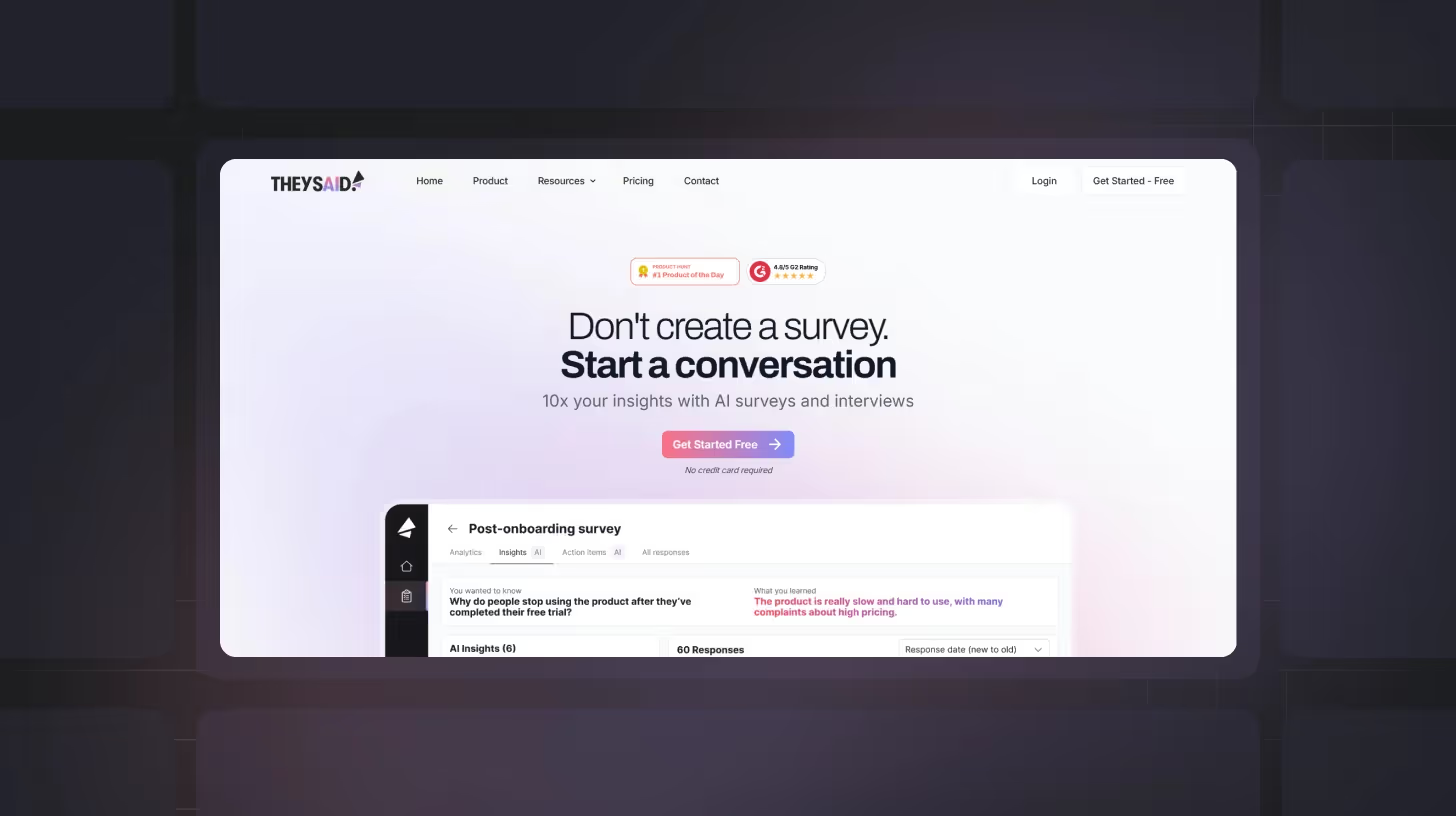
TheySaid is designed to run structured, conversational interviews and turn candidate responses into clear, actionable insights. Originally built for AI-led conversations, Evo is well-suited for hiring teams that value depth, fairness, and clarity over simple automation.
Key Features:
- AI-powered interviews with summarization
- Insight generation and follow-up actions
- Ideal for sales, support, and customer success roles
Curious Thing
Best for: Phone-based screening and asynchronous interviews
Curious Thing uses voice-based AI interviews to evaluate communication, critical thinking, and motivation. It’s great for roles where verbal reasoning and soft skills are key.
Key Features:
- AI voice interviews
- Personality and communication scoring
- Automated insights and reports
Modern Hire
Best for: End-to-end talent assessment
Modern Hire combines AI with industrial-organizational science to deliver validated assessments, structured interviews, and automated scoring for better hiring outcomes.
Key Features:
- Pre-employment assessments
- AI-driven interview analysis
- Validated selection science
HireVue
Best for: Enterprises and high-volume hiring
HireVue offers AI-powered video interviewing and game-based assessments. Its machine learning algorithms evaluate candidates’ verbal and non-verbal cues, helping companies like Unilever and Goldman Sachs make faster, data-backed hiring decisions.
Key Features:
- Video interviews scored by AI
- Predictive analytics
- Skill and behavioral assessments
Paradox (Olivia)
Best for: Hospitality, retail, and frontline roles
Paradox is known for Olivia, an AI recruiting assistant that automates scheduling, screening, and interview reminders through a conversational chatbot interface.
Key Features:
- Real-time chatbot interactions
- Seamless ATS integrations
- Mobile-first candidate experience
How to Choose the Right AI Interview Assistant Tool
Choosing the best AI interview assistant means finding a tool that fits your hiring needs and improves your process. Here’s what to look for:
- Match Your Hiring Goals: High-volume, specialized, remote? Pick a tool that suits your needs.
- Integrations Matter: Make sure it works well with your ATS and other software.
- Good Candidate Experience: Easy to use, mobile-friendly, and gives clear feedback.
- Fairness & Transparency: Check for bias controls and clear AI explanations.
- Scalable & Supported: Can it grow with you? Is customer support reliable?
- Pricing & Value: Understand costs and make sure it saves time and money.
Test a few options to find the perfect fit for your team and candidates.
Are AI Interview Assistants Ethical and Fair?
Benefits:
- Standardize interviews by asking the same questions to all candidates
- Use data-driven evaluations instead of gut feelings
- Detect and reduce biased language or patterns
Concerns:
- Training data may carry existing biases, leading to unfair results
- Lack of transparency on how AI scores candidates
- Privacy issues with handling sensitive candidate data (video, voice, text)
Best Practices for Ethical Use:
- Conduct regular audits to catch and fix bias
- Keep human oversight in hiring decisions
- Be transparent with candidates about AI use
- Comply with legal standards like GDPR and EEOC
Final words
AI interview assistants have become essential for hiring teams that need speed, structure, and fairness, especially in remote and high-volume hiring. When used responsibly, they help standardize interviews, reduce bias, and give recruiters clearer signals to make better decisions.
Among the tools available today, TheySaid stands out as one of the best AI interview assistant solutions for teams that care about interview quality, structured conversations, and actionable insights, not just automation.
Don’t let top talent slip away. Join TheySaid now and make faster, smarter hiring decisions.
Key Takeaways
- AI interview assistants help hiring teams run structured, consistent interviews that are easier to compare and defend.
- They significantly reduce time-to-hire by automating scheduling and early-stage interviews.
- Standardized questions and evaluation criteria support hiring fairness and bias reduction.
- AI interview assistants enable remote and global hiring without time-zone or availability issues.
- The best AI interview assistant tools combine automation with actionable insights, not just scoring.
- Ethical use requires human oversight, transparency, and regular bias audits.
- For teams focused on interview quality and continuous improvement, TheySaid stands out as one of the best AI interview assistant solutions.
FAQs
Will AI interview assistants replace human interviewers?
No. AI interview assistants support hiring teams by handling structured interviews and analysis, while humans retain full decision-making authority.
Can AI interview assistants assess soft skills?
AI interview assistants can analyze communication patterns such as tone, clarity, and structure, but soft skills should always be validated by human reviewers.
Are AI interview assistants secure and private?
Reputable tools follow data protection standards like GDPR and clearly communicate how candidate data is collected, stored, and used.
Are AI interview assistants ethical to use?
Yes, when used responsibly. Ethical use includes transparency with candidates, regular bias audits, and keeping humans involved in decisions.


.svg)


