



The way you phrase survey questions determines the quality of the answers you get and how useful those questions actually can be.
For example, when you ask neutral, precise questions, people respond with clarity, giving you honest and thoughtful feedback. But if you ask a question that injects an assumption, a hint of judgment, or even a subtle nudge, you are likely to get biased feedback that isn’t very useful.
One very common source of biased survey questions is loaded questions, so what exactly are they, and how can we prevent them?
We’ve put together this guide on loaded questions to walk you through everything you need to know.
30 Sec Summary
Loaded questions in surveys can subtly influence how respondents answer, often leading to biased or unreliable results. Unlike neutral questions, they carry hidden assumptions or pressures that distort feedback. To collect accurate and actionable insights, it’s important to phrase questions clearly, fairly, and without leading or loaded language, ensuring participants can share their genuine opinions.
What Are Loaded Questions?
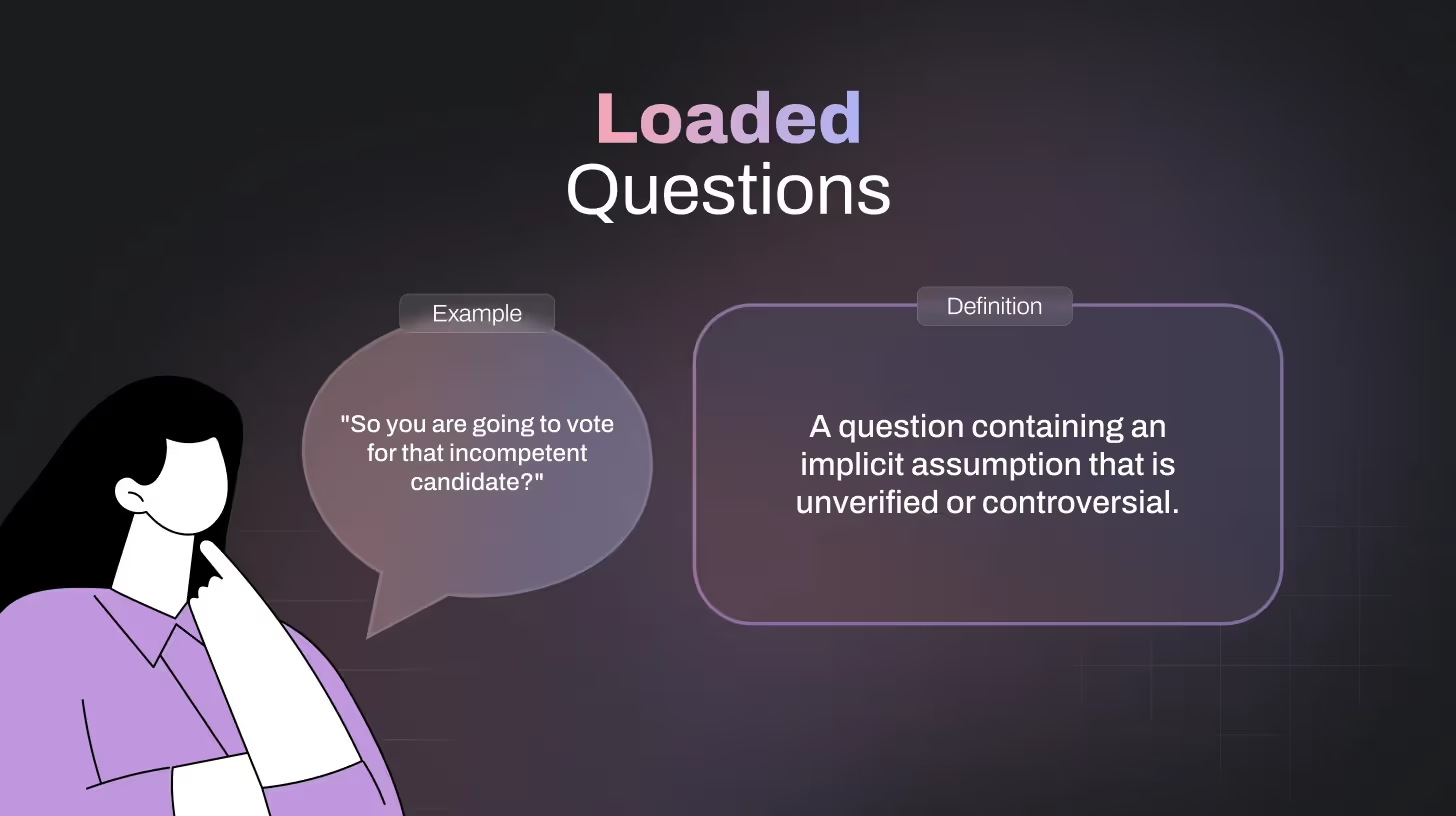
By definition, a loaded question includes an implicit assumption, bias, or implied viewpoint that influences how someone responds. These questions can take on a slightly manipulative tone, making people feel uncomfortable or even defensive.
Loaded questions are sneaky because they induce logical fallacies. Instead of capturing honest feedback, they push respondents toward a particular answer, which ends up distorting the data in most cases.
To make this clearer, let’s look at a simple example of a loaded question
“How much did our new feature improve your workflow?”
The phrase “feature improved” assumes the feature was helpful, which can influence respondents’ answers. If someone didn’t find it useful, they might feel forced to respond positively or explain why it didn’t work for them. This can distort the feedback you receive, making it less reliable.
A more neutral alternative would be: “How would you describe your experience with the new feature?”
This phrasing removes the assumption and gives customers space to answer honestly, which means you get feedback you can actually rely on.
Difference Between Loaded and Leading Questions
There’s a subtle difference between leading and loading questions, but both can impact the quality of survey responses.
Loaded questions often imply something is true, making respondents feel like they’re being “tested” or nudged toward a particular answer.
Leading questions, on the other hand, steer people toward a response through wording or tone. They hint at what the “right” answer is, even if no assumption is directly made.
In other words, with a leading question, respondents usually know the context but may feel nudged to answer a certain way. With a loaded question, the phrasing itself can create pressure or discomfort, making honest feedback harder to get.
Can A Survey Question Be Both Leading And Loaded?
Absolutely! A survey question can sometimes be both leading and loaded.
Take this example: “Don’t you agree that the new policy will greatly benefit the company?”
Here, the question assumes the policy will have a positive impact. (loaded) And the wording nudges the respondent toward agreement. (leading).
Questions like this make it tough for customers to answer honestly, and the feedback you get ends up reflecting the question, not their real experience.
Recommended blog: Leading and Loaded Questions: The Survey Killers (And How to Fix Them)
Examples of Loaded Questions in Surveys
Here are some common loaded-question examples you might encounter in traditional surveys.
Double-Clause Loaded Question
“Do you love our new feature because it’s genuinely helpful, or are you just saying that to support the team?”
In this example, the question forces the respondent to pick between two extremes. If they disagree with one, they automatically confirm the other. It presupposes that there are only these two reasons for liking the feature, which may not be true.
A better and more bias-free way of asking this question would be: “How would you describe your experience with the new feature?”
Presumptive Question About Product Adoption
“Are you using our new dashboard because it’s easier than the old one, or are you just trying to avoid learning the old system?”
In this example, the question assumes the user is using the dashboard for one of these two reasons. If the respondent hasn’t used your dashboard, they will pick a random option; even if they have, it still pushes them into an uncomfortable choice.
You can solve this using Question Skip Logic. Ask early in the survey whether they have used your new dashboard. This way, only relevant respondents see the follow-up questions, keeping your data accurate and meaningful.
However, a neutral way of asking this question would be: “What influenced your decision to use the new dashboard?”
Yes/No Pressure Question
“Can you complete the setup by tomorrow, or are you too busy to prioritize it?”
In this example, the question puts a lot of pressure on the respondent. Saying “no” can make them seem negligent or unmotivated, even if there’s a valid reason.
Here’s a better way to ask this question: “When would be the best time for you to complete the setup?
Open-Ended Presupposition
“Why do you find our AI tool better than other solutions?”
By putting forward this leading question, you imply that the respondent already finds the tool better, pushing them toward agreement. Even though it’s open-ended, it subtly biases the response.
Here’s a less biased version of this question you can ask: “How does our AI tool compare to others you’ve used?
A well-known example of loaded questions affecting real decisions came from a survey conducted by the UK’s Office for National Statistics. When researchers asked parents, “How much do you enjoy reading to your child?” responses skewed overwhelmingly positive.
However, when the question was rephrased neutrally to “How often do you read to your child?” the results revealed that many parents rarely did. This demonstrated how presuppositions (“enjoy”) push participants to answer in socially desirable ways. Source
Assumptive Question About Customer Satisfaction
“What do you like most about our support team?”
In this example, the question assumes the respondent likes your support team, even though they might never have contacted them or may not have had a positive experience.
Better way to ask it: “How would you describe our experience with our support team?”
How To Respond To A Loaded Question?
Well, if you ever find yourself in a situation where someone asks you a loaded question, here’s how to respond wisely.
Focus on facts and ignore assumptions: If the question presumes something that isn’t true for you, pause for a moment and answer based on your experience, ignoring the assumption.
Address the presumption: The other option is to politely call out the hidden assumption. For example, “I think that might not be accurate…” or “I don’t see it that way…”
Mentally reframe the question: Reword it in your head neutrally before answering to avoid being swayed by biased phrasing.
How To Avoid Asking Loaded Questions
Loaded questions can be easily screened out with careful planning and advanced AI survey tools such as TheySaid. Let’s break down the techniques in detail:
Think About Who’s Taking Your Survey
Ask yourself: who’s actually answering these questions? Are they regular users, new sign-ups, or just people checking things out? Knowing your audience helps you ask questions they can actually answer.
Use Question Logic Wisely
As discussed above, the best practice is to use skip logic or conditional questions to ensure that only relevant respondents see the questions that apply to them.
Test Before You Launch
Preview your survey and share it with colleagues, friends, or even a small group of customers. Ask them:
- Did any question feel biased or push you toward a particular answer?
- Were you ever unsure how to respond?
This step helps you spot loaded questions before they reach your broader audience.
Keep Questions Open and Neutral
Whenever possible, frame questions neutrally and allow respondents to express their true opinions. Avoid phrasing that nudges them, presumes an outcome, or limits their options. Open-ended, balanced prompts are your best friends here.
How AI tools (like TheySaid) automatically detect loaded questions
Modern AI, particularly in survey platforms like TheySaid, addresses the problem of loaded questions at scale. By leveraging advanced technologies such as Natural Language Processing (NLP), behavioral linguistics models, LLM-based bias detection, semantic scoring, and question intent recognition, TheySaid can automatically identify subtle issues in survey questions before they affect your data.
The system scans for:
- Emotional bias embedded in wording
- Assumptive phrasing that presumes experiences
- Leading sentence structures that nudge responses
- Double meanings or ambiguous language
- Inconsistent question flow that confuses respondents
As more companies adopt voice-of-customer recordings, AI-voice surveys, and conversational feedback tools, loaded questions can have an even bigger impact. Tone, phrasing, and context in voice responses can subtly influence feedback, making it harder to capture true sentiment.
Platforms like TheySaid mitigate this by:
- Rewriting prompts for neutrality
- Detecting tone-loaded or emotionally charged language
- Identifying implied assumptions in questions
- Structuring open-ended questions to capture unbiased, authentic sentiment
By combining AI and voice technology, TheySaid ensures that your surveys, whether text-based or voice-enabled, collect honest, actionable feedback without being distorted by loaded questions.
Top revenue and customer leaders trust TheySaid for accurate, bias-free customer insights. See it in action. Request your demo.

FAQs
Why are loaded questions a problem in surveys?
They distort the feedback you receive, making it difficult to rely on your survey data for decision-making or improvements. Responses often reflect the question’s wording rather than the respondent’s true experience.
How can I avoid using loaded questions?
Use neutral, clear phrasing, open-ended questions, and skip logic where appropriate. Test your survey with a small group first to spot biased or confusing questions.
Can AI tools help detect loaded questions?
Yes. Modern AI survey platforms can identify subtle biases, emotional cues, or assumptive language in questions, helping you create surveys that capture honest and actionable responses.




.svg)