



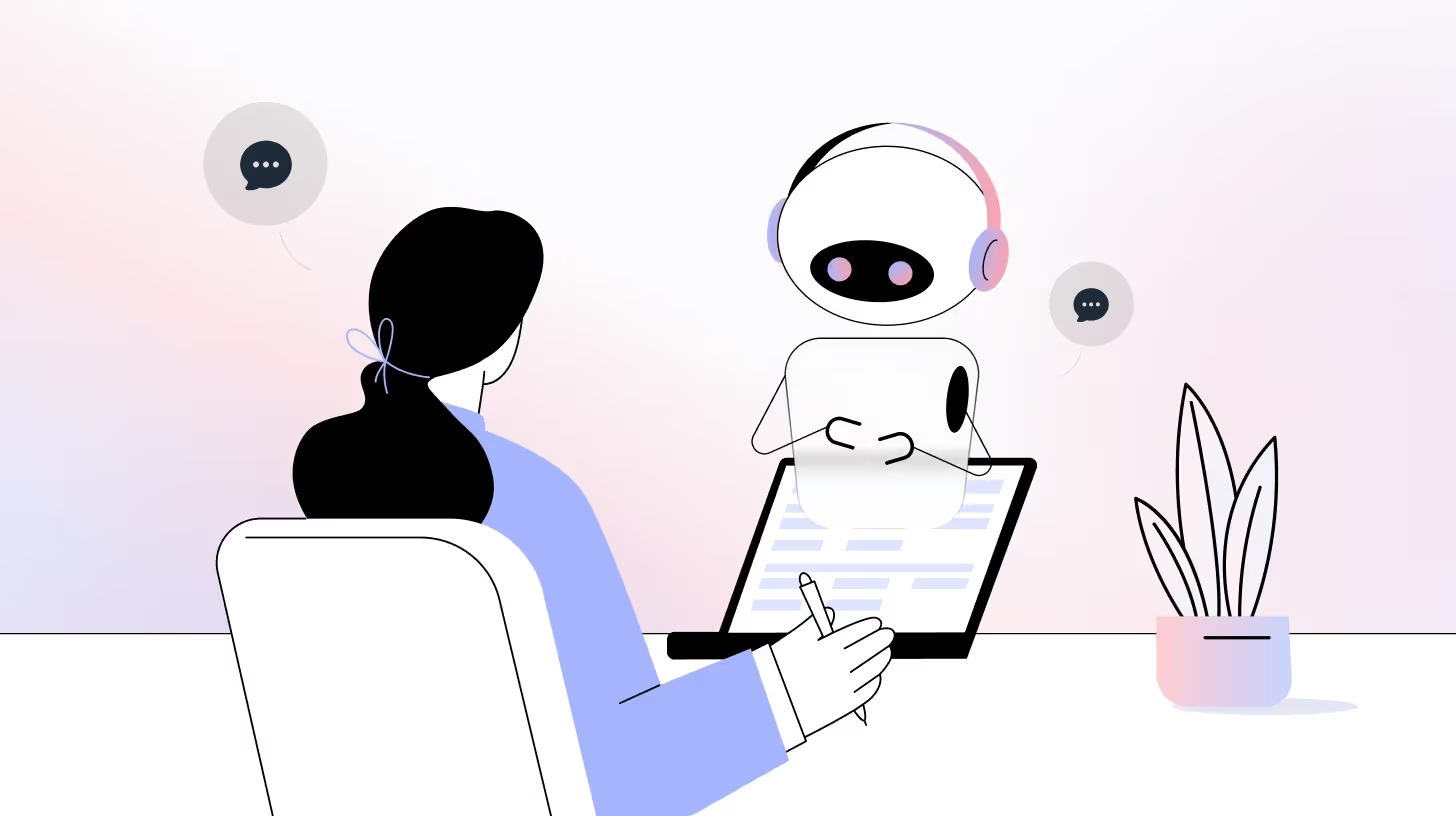
You just applied for a job and got an interview request. But it’s not with a person. It’s with an AI.
Sound strange? It’s more common than you think. By the end of 2025, nearly 70% of companies are projected to utilize AI in their hiring processes, with approximately 43% planning to conduct AI-driven interviews.
Artificial intelligence is no longer just a tool for automation; it's changing how businesses engage with customers, employees, and potential product users. This shift reflects a broader movement towards streamlining, efficiency, and data-driven decision-making.
AI interviews use technologies like natural language processing and machine learning to improve the structure and consistency of human-led interviews. But what exactly is an AI interview, and how does it work?
In this guide, we'll explore the mechanics of AI interviews and how they’re transforming recruitment and business operations. We’ll also guide you on how to run your own AI interview using TheySaid.
What are AI Interviews?
AI interviews are a modern solution that leverages artificial intelligence to conduct interviews and provide businesses with valuable insights on candidates, customers, and employees. These interviews can be used for job recruitment, customer research, product feedback, or post-sale follow-ups.
Unlike traditional interviews, which rely solely on human interaction, AI interviews use algorithms and machine learning models to analyze responses and behaviors and identify meaningful patterns.
Some AI interviews are fully automated, in which the customer answers a set of questions on screen or via voice, and AI handles the rest. The other ones are semi-automated, in which AI assists the human interviewer with notes, interaction, and follow-ups.
Today, AI-powered interviewing is widely used in AI interviews for recruitment, customer research, employee feedback, and product discovery making it a core part of modern interview techniques.
AI interviews use the following technologies:
- Natural Language Processing (NLP) – to understand and interpret human language
- Machine Learning (ML) – to learn from responses and improve over time
- Sentiment Analysis – to detect tone, emotion, and intent
- Speech Recognition (in voice-based interviews) – to transcribe and analyze spoken answers
Why AI Interviews Matter in Modern Interview Techniques
The role of AI in interviews has evolved from simple automation to full-scale interview analysis. Traditional interview methods struggle with scale, consistency, and unbiased evaluation especially in remote and high-volume environments.
AI interviews introduce automated interviews, structured evaluation, and data-backed insights, allowing teams to make better decisions faster. This shift reflects how modern interview techniques prioritize consistency, speed, and actionable feedback over subjective impressions.
Key Benefits of AI Interviews for Businesses
The benefits of AI interviews go beyond automation. They help organizations run scalable, consistent, and insight-driven interviews while improving decision quality across teams.
- Scalable automated interviews: Run hundreds of interviews simultaneously without scheduling delays
- Consistent evaluation: AI applies the same criteria to every response, reducing bias
- AI interview analysis: Extract themes, sentiment, and patterns from open-ended responses
- Faster decision-making: Interview insights are summarized instantly instead of manually reviewed
- Better candidate and respondent experience: People respond on their own time, from anywhere
AI Interviews vs Traditional Interviews: Key Differences
AI interviews differ from traditional interviews by using automation, AI interview analysis, and standardized evaluation criteria.
While traditional interviews rely on manual scheduling and subjective judgment, AI-powered interviewing enables scalable, consistent, and data-driven conversations across hiring, research, and feedback use cases.
Availability and Scheduling
Traditionally, interviews take a substantial amount of time since they involve multiple rounds of interaction, and trying to find the right interview slots that best suit them. On the one hand, AI interviews streamline the whole process. Candidates can schedule interviews at their convenience, irrespective of the time zones. You get an instant link to record a video or chat with an AI bot, right after submitting your application, even at 2 am.
For example, a start-up CEO validating a product idea can get 300 responses overnight using AI interviews, which are far faster than traditional interviews.
Scalability
In traditional interviews, a recruiter takes 30 to 40 minutes on a single call. Multiply that by 100, and you’re looking at 50+ hours of manual interviews just to shortlist people. At the same time, AI can conduct hundreds or thousands of interviews simultaneously and score and analyze the responses instantly.
For example, a marketing team wants to find out why their leads are not converting using the traditional method. They might be able to interview 10 people a week; however, with AI, they can interview 500+ leads in a week.
Did You Know?
L’Oréal receives over 1.5 million job applications every year, and it’s using AI interviews to manage the volume. Automating early-stage screening has streamlined the candidate experience and made hiring faster and fairer worldwide. Listen to the interview.
Depth of Analysis
Traditional interviews rely on a subjective assessment limited by time or experience. In contrast, AI interviews extract deeper insights using sentiment analysis, linguistic patterns, and behavioral cues such as long pauses or voice drop-offs.
For example, A hiring team might notice that top-performing candidates mention specific problem-solving frameworks (like STAR or SWOT). This becomes the data-backed hiring signal that might be missed with traditional interviews.
TheySaid Insights on this:
Companies use AI to analyze open-text buyer interviews at scale. Instead of guessing why deals were lost, teams get structured themes like "pricing concerns," "missing integrations," or "lack of urgency" sorted by frequency and buyer sentiment.
Consistency and a standardized evolution process,
Human interviewers bring different expectations, experience, and human biases to the table. This can lead to inconsistent evaluations. Questions may also be phrased differently, which can affect respondents’ performance. Whereas AI interviews use a language-neutral approach, they evaluate responses based on pre-defined criteria such as keywords, tone, sentiment, and structure, making it a fair and more reliable method.
For example, in a hiring context, two candidates might answer the same question with similar content and different styles. The human interviewer might evaluate them based on who is more charismatic, but AI will determine the core content, check the relevance with job requirements, and ensure consistency.
Recommended Read: The Role of AI in Enhancing Survey Experiences
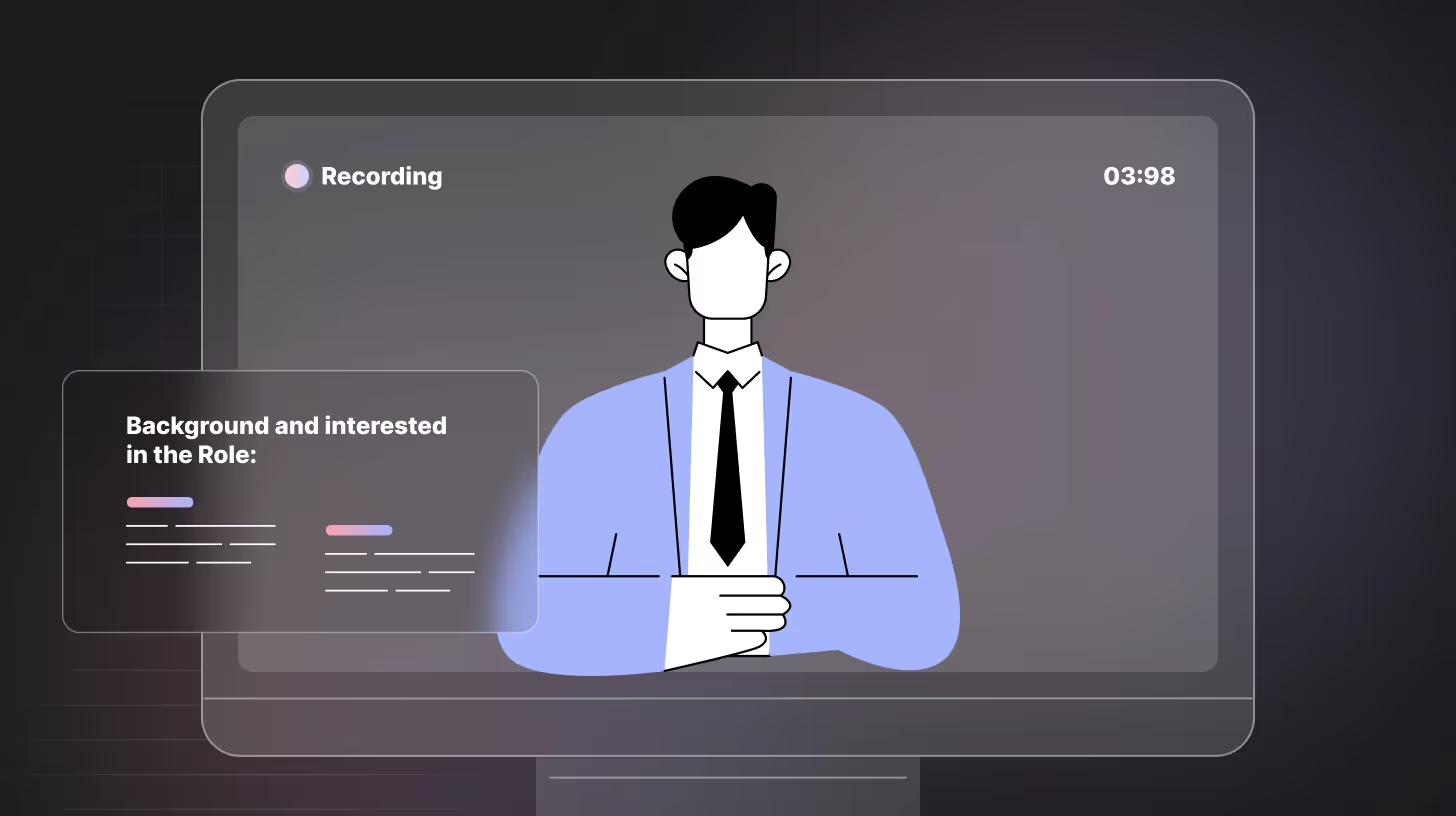
Types of AI Interviews
AI interviews come in different formats depending on how automation and analysis are applied. Understanding these types of AI interviews helps teams choose the right approach for hiring, research, or feedback collection.
Asynchronous AI Interviews
Candidates or participants respond to pre-set questions on their own schedule. These automated interviews are commonly used in recruitment, customer research, and large-scale feedback collection.
Conversational AI Interviews
Conversational AI interviews adapt in real time, asking follow-up questions based on responses. This AI-powered interviewing approach feels more human and is effective for uncovering deeper insights.
AI Interview Analysis–Driven Interviews
In this format, the focus is on AI interview analysis rather than question delivery.
AI evaluates sentiment, language patterns, and themes across interviews to generate structured insights.
AI Interview Analysis: How Insights Are Generated
AI interview analysis turns open-ended interview responses into structured, actionable insights.
Instead of manually reviewing transcripts, AI analyzes language, sentiment, and patterns across interviews to help teams make faster, data-driven decisions.
How AI Analyzes Interviews
- Language & keyword analysis: Identifies recurring terms, phrases, and concepts
- Interview sentiment analysis: Detects tone, confidence, hesitation, and emotional cues
- Pattern recognition: Surfaces trends across hundreds or thousands of interviews
- Insight summarization: Converts raw responses into themes, risks, and opportunities
In practice, teams use AI interview analysis to understand why candidates drop off, what customers struggle with, and which themes consistently impact decisions.
AI Interview Use Cases by Team
AI interviews are used across hiring, sales, product, and internal teams to scale conversations and extract insights consistently. Below are the most common AI interview use cases, grouped by team and objective.
Recruiters – Smarter Candidate Screening
Recruiters use AI interviews for recruitment to automate early-stage screening, reduce bias, and compare candidates using structured interview data.
Recruiters often face the challenge of reviewing many resumes and conducting initial phone interviews. AI can automate the initial screening process. Candidates can answer recorded questions, and AI evaluates answers based on sentiments, skills, and relevance to the job, enabling recruiters to focus on talent only.
For example, Unilever uses AI interviews for mass recruitment. They scale their candidate screening to handle thousands of applicants while maintaining a consistent, bias-free evaluation process.
Sales – Learning from Lost Deals
Sales teams use AI interview analysis to run structured win/loss interviews and uncover patterns behind deal outcomes.
In sales, understanding why deals are lost can be just as valuable as knowing why deals were won. With AI interviews, sales teams can automate win/loss analysis by conducting structured interviews that provide insights into their decision-making process. These insights help teams refine their product strategies and ultimately increase their win rates.
For example, a B2B SaaS team uses AI interviews to find out why leads drop off after demos. Responses reveal that many felt the onboarding process seemed too complex. The sales team works with product and customer success to simplify documentation and training materials, resulting in a 12% lift in conversions the next quarter.
If you want to do a win/loss analysis for your business, sign up for TheySaid now and start turning lost deals into valuable insights!
Marketing – Customer Research at Scale
Marketers rely on AI-powered interviewing to capture buyer insights, test messaging, and analyze sentiment at scale.
Marketers conduct AI interviews to understand buyers' motivations, preferences, brand health, and customer satisfaction. The feedback helps them shape messaging, positioning, and campaign strategies. Shoify uses AI to collect user feedback about new features, providing real-time insights that guide its marketing and product strategies.
Recommended read: 8 Types of Market Research Surveys Every Marketer Should Know
Product Management – Validating New Features
AI interviews let product teams test different features before launching them. You can quickly gather thousands of responses and efficiently analyze responses to identify trends and user sentiment about new features or product releases.
For example, Apple uses AI interviews with beta testers to gather user feedback on software features, helping them make data-driven decisions before launching new updates.
Managers – Better 1:1s and Pulse Checks
Managers use automated interviews to collect employee feedback consistently across remote and hybrid teams.
Team leads use AI interviews to gather employee feedback regularly, socially in remote or hybrid settings. These interviews help uncover stressors, burnout, or career development needs. For example, Salesforce leverages AI to gather regular employee feedback through pulse surveys to gain insights into employee satisfaction and employee engagement.
Startup Founders – Fast Customer Discovery
Startups use AI interviews to test product-market fit early on. It's a scalable way to validate if the idea is worth building before actually spending time and resources on it. For example, a founder used AI interviews to talk to 200 busy professionals about a meal-planning app. Most said the real struggle was grocery shopping, not cooking. So, they shifted focus to a grocery-planning feature and saw a big spike in user interest.
Did you know?
Companies that adopt AI interview solutions see measurable results:
- 75% reduction in screening costs
- 50% decrease in scheduling time
- 40% boost in recruiter productivity
- 10% improvement in employee retention
AI interviews aren’t just smart, they deliver real ROI.

Recommended read: How to Give an Interview Using AI (Step-by-Step Guide for Job Seekers)
Pros and Cons of AI Interviews
AI interviews bring speed, scale, and consistency to conversations, but like any technology, they come with trade-offs. Understanding both the benefits and the limitations can help teams decide when and how to use them effectively.
Pros
- Reduces the impact of human biases by providing data-driven assessments
- Whether it’s 10 or 10,000 people, AI can handle it with no scheduling headaches.
- AI analyzes a massive amount of interview data incredibly quickly, providing rich insights that lead to better decision-making.
- It picks up on things like tone, pace, and keywords that a human might miss.
- People can respond anytime, anywhere, without the need to book a time slot.
Cons
- Talking to a bot just doesn’t feel the same as talking to a real person.
- AI might not catch sarcasm, humor, or subtle emotions like a human would.
- Not everyone’s comfortable sharing personal info with an algorithm.
- If not trained properly, AI tools can reinforce biases or misunderstand context.
- There’s a risk that personal data from AI interviews could be leaked or misused if not protected.
Examples of AI Interview Questions
AI interviews rely on structured, open-ended questions that adapt to different goals from hiring and sales to customer research and product validation. Below are examples of AI interview questions commonly used across teams.
For Job Candidates
These AI interview questions for recruitment help assess motivation, communication style, and problem-solving ability early in the hiring process.
- What type of work environment helps you thrive?
- Why are you interested in this role, and what value would you bring?
- Share an example of when you have overcome any work challenge.
For Win/Loss Sales Interviews
Sales teams use these AI interview questions to understand buying decisions and identify drop-off patterns at scale.
- Why did you choose not to move forward with our solution?
- Which alternatives did you consider, and why?
- Was there anything unclear or confusing during the sales process?
For Customer Feedback
These questions support AI interview analysis by uncovering sentiment, satisfaction drivers, and improvement areas.
- What’s been your experience with our product or service so far?
- What’s one thing you wish worked better?
- How likely are you to recommend us to others, and why?
For Product Testing & Feature Validation
Product teams use these AI-powered interview questions to validate real user needs before investing in development.
- How do you currently solve [ problem]?
- Would [feature idea] be useful in your workflow? Why or why not?
- What’s the biggest frustration you face when using tools like ours?
Recommended Read: Top 80 AI Interview Questions for Job Interviews in 2026
How to Run an AI Interview with TheySaid
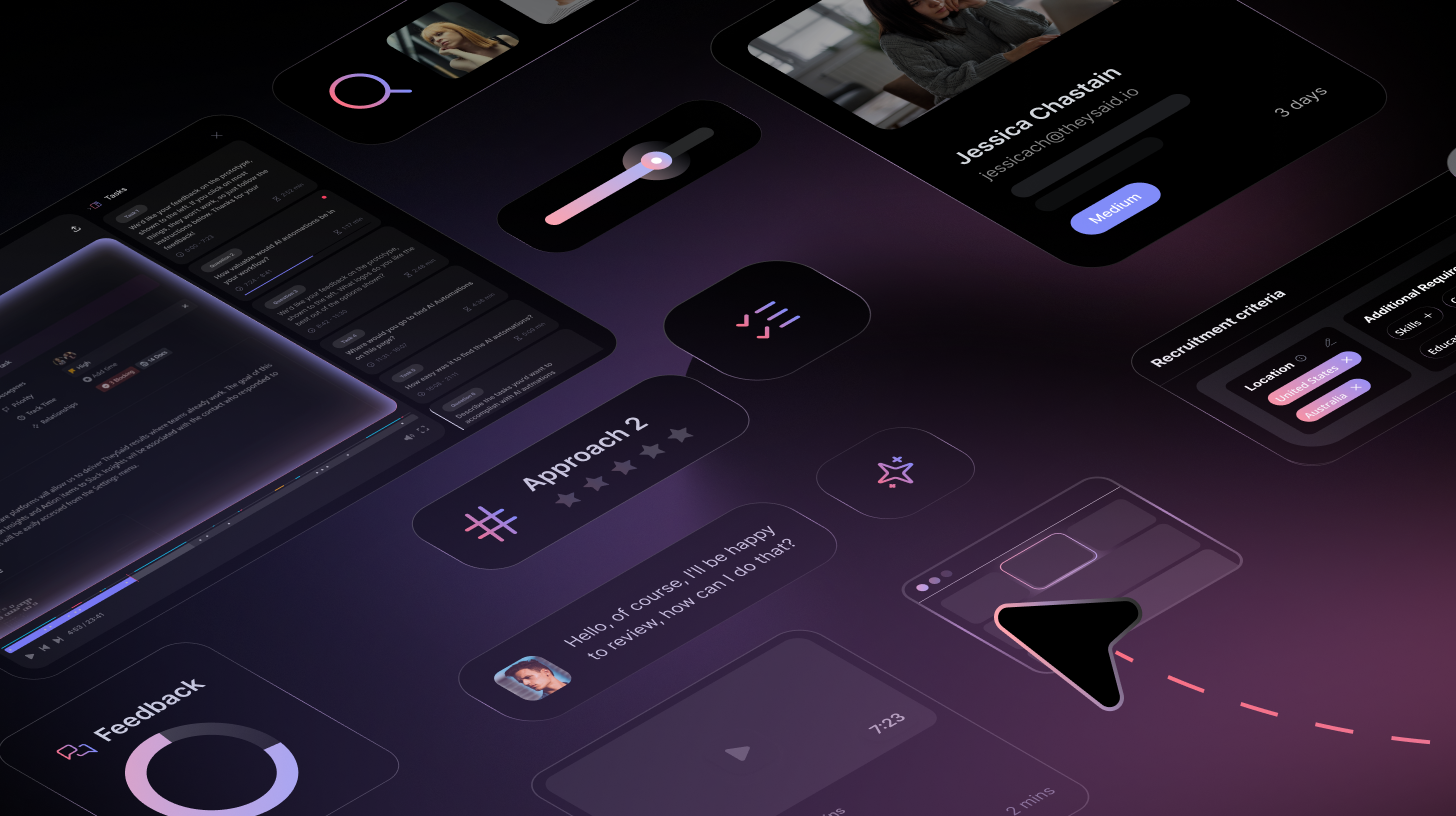
Running AI interviews with TheySaid combines conversational AI interviewing with automated interview analysis. Instead of rigid surveys or scripted calls, teams use TheySaid to run structured, adaptive interviews and instantly turn responses into actionable insights.
Step 1: Give TheySaid a Starting Point
Just drop your website link or a short sentence about what you're trying to learn. For example, we just launched a new feature and want customer thoughts. Or I need honest feedback from my team about our new process. The AI takes it from there, so no strategy meeting is required.
Step 2: Pick ‘AI Interview’ from the Dashboard
You’ll see options like Pulse, Survey, and AI Interview. Click the one that actually listens: AI Interview. Then, choose what you’re curious about: How users feel about a new feature,
What customers really think about support, you pick the topic. TheySaid builds the brain.
Step 3: Let AI Draft the Interview for You
TheySaid comes with proven, expert-crafted AI question templates. You can also tweak or write your own; no code or AI skills are needed.
Step 4: Send It Out (No Fancy Tools Needed)
You can launch your AI interview via email, in-app widget, QR code, or Slack message.
Basically, however your people talk to you, they can talk to TheySaid.
Step 5: Watch the AI Talk to Humans (Like a Pro)
Users respond, and the AI chats with them like a seasoned interviewer, asking follow-ups, clarifying responses, and diving deeper when something’s interesting. Wait, what did you mean by that? Tell me more about that experience. It’s human. It’s dynamic. It’s everything surveys wish they could be.
Step 6: Let AI Do the Boring Stuff
Once the responses roll in, TheySaid gets to work: Summarizes the top themes, Spots patterns you didn’t know existed, flags red flags, and suggests action steps.
Ready to scale smarter with AI interviews? Try TheySaid and get insights that drive action, no scheduling hassles, just real conversations.
Key Takeaways
- AI interviews allow you to collect hundreds of responses without scheduling conflicts.
- You can surface rich, data-backed insights faster than traditional interviews.
- Standardized AI evaluations help reduce bias and improve consistency.
- Sentiment analysis reveals tone, intent, and hidden concerns in responses.
- Feedback is instantly summarized into action items and next steps.
- You can validate product ideas or messages quickly before investing in them.
- AI interviews help different teams align faster around customer or employee insights.
- TheySaid makes the entire process seamless and scalable, from setup to insights.
FAQs
What are AI interviews in hiring?
AI interviews are interviews conducted or supported by artificial intelligence to automate questioning, analyze responses, and generate insights during the hiring process.
How do AI interviews work?
AI interviews work by asking structured or conversational questions and using AI interview analysis such as NLP and sentiment analysis to evaluate responses at scale.
What are the benefits of AI interviews?
The main benefits of AI interviews include faster screening, reduced bias, consistent evaluation, better candidate experience, and scalable interview data analysis.
Are AI interviews replacing human interviews?
No. AI interviews support early-stage screening and large-scale analysis, but final hiring decisions still require human judgment.
Are AI interviews fair and unbiased?
AI interviews can improve fairness through standardized questions, but they must be monitored for bias, trained responsibly, and used with human oversight.
What is AI interview analysis?
AI interview analysis is the process of using AI to evaluate interview responses for sentiment, language patterns, intent, and recurring themes.
What types of AI interviews are there?
Common types include asynchronous AI interviews, conversational AI interviews, and AI interviews focused primarily on post-interview analysis.
Can AI interviews assess soft skills?
AI interviews can analyze communication style, clarity, tone, and confidence, but soft skills should always be validated by human reviewers.
Are AI interviews only used for recruitment?
No. AI interviews are also used for customer research, win/loss analysis, product feedback, employee engagement, and internal pulse checks.
What role does AI play in modern interview techniques?
AI enables modern interview techniques by automating interviews, scaling conversations, and turning open-ended responses into structured insights.
Are AI interviews secure and private?
Reputable AI interview tools follow data protection standards like GDPR and ensure candidate responses are stored and processed securely.
When should companies not use AI interviews?
AI interviews may not be suitable for highly sensitive conversations, executive hiring, or situations where deep human context is required.
What’s the difference between AI interviews and video interviews?
AI interviews analyze responses using AI, while video interviews may simply record answers without structured interview analysis.
Do candidates like AI interviews?
Many candidates prefer AI interviews because they are flexible, asynchronous, and eliminate scheduling pressure when designed transparently.
What is the future of AI interviews?
The future of AI interviews includes more conversational AI, better interview analysis, improved fairness controls, and deeper integration into hiring workflows.


.svg)


