















Built on real behavior
Every synthetic tester starts from a base model trained on 100,000+ hours of real usability sessions — how people actually hesitate, misread and give up.
Put what you’re building in front of real customers — or synthetic users trained on them when you need an answer in minutes — without leaving Claude, v0, Replit, Cursor, or Lovable. Nothing ships on a guess.
No credit card. First test in under 5 minutes.
No credit card required.
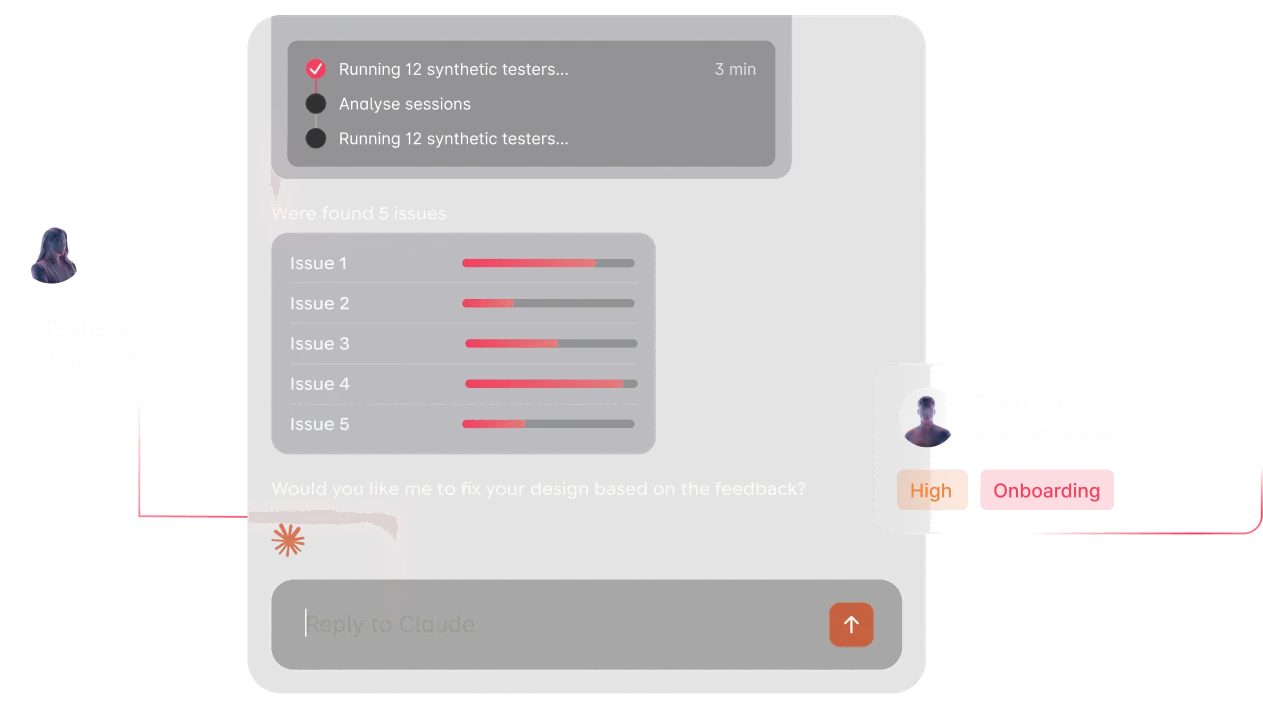
Runs inside the tools you already use, nothing new for your team to learn


Every month your team ships more decisions — designs, tickets, PRs. The ability to check them with customers hasn't moved in a decade: schedule interviews, recruit a panel, wait two weeks. The gap fills with guesses, and guesses compound.
Validation can't be a project anymore. It has to be infrastructure — running every time you ship.
Connected once, by one
person — in [X] minutes
Nobody on your team logs
into anything new
Nobody has to remember to
run it — tickets trigger it
Ask for feedback without leaving the canvas. When a ticket hits “Design Done,” customer validation runs automatically, attaching the evidence to the ticket—no one needs to remember to ask. TheySaid runs the test, returns the findings, and gives you the prompt to fix them.


Test design with our target users


Would you like me to fix the design problems identified?


Design Done
 Customer validation
4 min ago
TheySaid showed your feature to 12 users, and found 1 issue that needs fixing before you ship.
A tester reviews your design or product, recorded like a real session.
Every hesitation, complaint and “wait, where is…” — transcribed, timestamped, clipped.
TheySaid shows what broke and gives a prompt to paste into Claude or your editor.
Run it with real customers, or with synthetic testers when you need an answer in minutes.
Human | Synthetic
One test builder. One set of Audiences. Three kinds of evidence.
Human Audiences
Real people use your design, share screens, and think out loud. Use them for confidence before a big bet.
Synthetic Audiences
They follow tasks, share screens, and think aloud quickly. Use them to narrow options and set early design and product direction.
Expert AI Reviewer
An expert critique of the experience against your spec and best practice, before anyone else sees it.



User feedback
Not generic personas. Testers built from real sessions and tuned to your customers.
Every synthetic tester starts from a base model trained on 100,000+ hours of real usability sessions — how people actually hesitate, misread and give up.
Connect the data you choose — call recordings, surveys, support tickets, CRM — and testers learn how your buyers and users think and talk.
No customer data yet? Start with a pre-built Audience for your market and refine it as you learn.
We run the same tests with synthetic and human testers on the same designs, and publish how often they agree — so you know how far to trust the result.
Every month your team ships more decisions — designs, tickets, PRs. The ability to check them with customers hasn't moved in a decade: schedule interviews, recruit a panel, wait two weeks. The gap fills with guesses, and guesses compound.
 79% found by both
 10% found by synthetic users
 1% found by human testers
Run the same test across roles and compare how buyers, users and execs react to the same design — in one report.

 Buyer
Buyer End user
 Exec
Exec


Results in minutes — choose Fast Mode for a quick read or Full Mode for a complete session. Screen and voice are recorded with think-aloud, just like a real session, and you can rerun after every change with no extra effort.
 Julia
Julia
Why is shipping only shown after I add to cart? I almost left I needed to know the total first.

Use your own customers, testers we recruit, or third-party panels — screened, scheduled and paid for you, with results in hours. All through the same test builder, same audiences, same report.
 John98%
 Jean
Jean Junior
 22–28 yr
Junior designers at SaaS startups
22–28 yrYou decide what customer data tunes your synthetic testers, how AI interprets it and what it can act on. Screeners keep the wrong people out of human tests, and Response Quality Monitor keeps low-effort answers out of your analysis.





Training data sources
3 approved·1 excluded

One test builder. One set of Audiences. Three kinds of evidence.
Discover
Experience hub
Experience Hub streams and scores feedback; evidence enters backlog attached to tickets.
Design
Synthetic audiences
Synthetic Audiences and Expert AI Reviewer run from your design tool when there's something to react to.
Build
Spec check
Test the working build against the spec before the PR merges.
Monitor
Critical experiences
Critical Experiences are scored across the journey after release. You know if it worked.
Get 25x more customer validation for the same budget, on average. And it starts at just $1 per synthetic test.
| Talk to customers yourself | Pay a testing panel | TheySaid Human | TheySaid Synthetic | |
|---|---|---|---|---|
| Time to complete | Weeks | Days | Hours | Minutes |
| Who you hear from | Whoever agrees to a call | Professional testers | Your customers or screened testers | Audiences built from your customers |
| Cost per user | Your team’s hours | $50–100 | $12–24 | From $1 |
| Sample size | 5, if you’re lucky | 10–20 | 4x more for the same budget | As many as the decision needs |
| Rerun after a change | Start over | Pay again | Relaunch in one click | One click |
| Who has to run it | You | A researcher | From MCP, or automatically when a ticket moves | From MCP, or automatically when a ticket moves |

"Implementing TheySaid has led to a 5-10% increase in qualified leads from our existing customers in just a few months while reducing churn. The results speak for themselves."

"TheySaid's AI Surveys helped us step up our insight gathering game. It's smarter and more engaging for customers."

"How did TheySaid AI come up with such great question recommendations? These are questions that our teams really want to know and discussed internally a lot. I am impressed!"

"Integrating TheySaid has been a game-changer. We've seen a 5-10% decrease in customer churn with an increase in upsell opportunities since its implementation."

"Really easy to use and I think this might be one of the best ways to engage with your customers! Platform will really boost your customer engagement."



In a typical project, of all the issues discovered, 79% will come from both human and synthetic audiences, 10% only from synthetic, and 11% only from humans. So tests run only with synthetic will uncover 89% of total issues, but synthetic should always be included in testing because they catch problems that humans miss.
TheySaid is the first and only company with technology that allows synthetic testers to record their screen while speaking their thoughts aloud. The deliverable isn’t a wall of Claude text, it’s a video recording with audio of a synthetic customer, trained on your data, using your prototype, app, Claude concept, or website.
No. TheySaid runs inside the tools your team already uses — Claude Design, Claude Code, Cursor, Jira, and more. One person connects it once, in under 5 minutes. Nobody else logs into anything new, and nobody has to remember to run it — tickets trigger it.
Your own customers or people we recruit from our huge panel of testers. Screeners make sure only the right people get in. We schedule and pay them for you, and results come back in hours, not weeks.
Yes. You can test with your own customers, testers we recruit for you, or third-party panels. We screen, schedule, and pay participants for you, and results come back in hours, not weeks.
The ones you already use — nothing new to learn.
Synthetic tests finish in minutes. Tests with real people come back in hours, not weeks. One person can connect TheySaid in under 5 minutes, and you can run your first test in under 5 minutes.
Generic personas come from a prompt. TheySaid’s testers start from 100,000+ hours of real usability sessions, then learn from your own customer data. You can also run one test across roles — like buyers, end users, and execs — and compare how each one reacts.
Screeners keep the wrong people out of human tests before they start, and Response Quality Monitor removes low-effort answers before they reach your analysis.
Yes. TheySaid supports more than 70 languages across user tests, interviews, and surveys, so you can hear from customers around the world in their own language. TheySaid 4.0 adds auto-translation, so you can run the same study across markets without rewriting it.
Yes. TheySaid is SOC 2 and GDPR compliant, and you control what customer data AI can see and act on.
Run your first test inside the tools you already use. Bring in real customers when the decision calls for it.