




TLDR
Guerrilla usability testing is a quick and low-cost way to test a product by asking random people in public places to try it for a few minutes.
Sessions usually last 5–15 minutes and focus on simple tasks like signing up, finding information, or completing a small action.
The goal is to quickly uncover usability problems and understand how first-time users interact with a design.
Guerrilla testing works best for early prototypes, simple user flows, and fast design validation.
While it provides fast insights, it does not replace structured usability testing with carefully recruited participants.
What is guerrilla usability testing?
Guerrilla usability testing is a fast and low-cost user research method used to identify usability issues by asking random people in public places such as cafes, malls, or universities to test a prototype, website, or product for a short session, typically 5–15 minutes.
Let’s better understand it with an example
You launched your fitness app and went to a crowded Starbucks in downtown Austin. You spot someone who's not buried in their phone like the world is ending. You walk up, friendly but direct:
“Hey, sorry to bug you. I'm tweaking a new fitness app. Got 5 minutes?
I'll grab your next coffee or Venmo you $10 if you try a couple quick things on my phone and tell me what's weird or annoying.”
They say yes (most do when there's free coffee or cash involved). You hand over your device and give them 2–3 dead-simple tasks like “Sign up for a free trial,” “Find a gym near you,” or “Add a workout to your plan,” and you watch.
No talking much during the test; just observe: a finger hovering forever on a button, a loud sigh, tapping the logo thinking it's a back arrow, or someone saying out loud, “This makes zero sense.”
You thank them, buy the coffee (or send the Venmo), jot down notes, and walk away with fresh, unbiased problems you can fix the same day.
That's guerrilla usability testing in a nutshell.
Why is it called "Guerrilla"?
The name comes from guerrilla warfare, where small, fast-moving groups use surprise, speed, and improvisation to achieve results with very limited resources instead of large, planned, and expensive operations.
In UX, "guerrilla usability testing" borrows that idea:
- No big budget or lab
- No formal recruitment or scheduling
- Quick, opportunistic 5–10 min sessions with random people in public
The term was popularized in the 1990s–2000s by Jakob Nielsen and lean UX folks to describe scrappy, effective methods when you can't afford traditional testing.
Run guerrilla usability testing with TheySaid
TheySaid helps product teams run quick user tests, capture real feedback, and turn conversations into actionable insights using AI.
Start your first test free!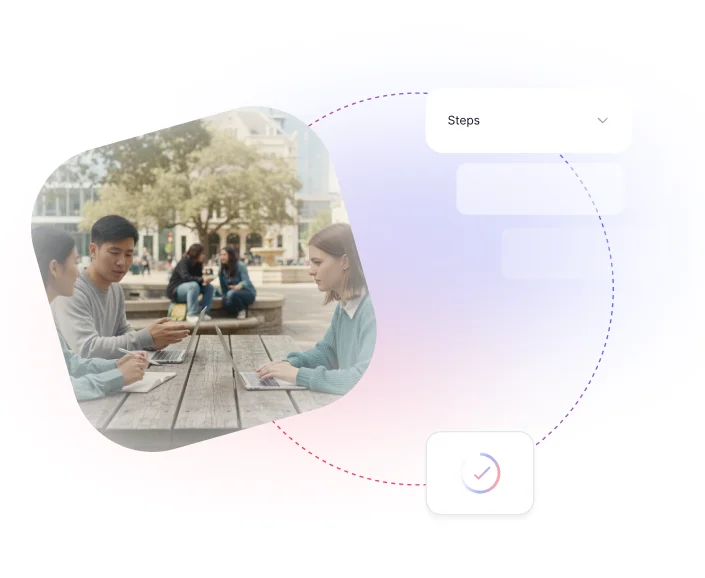
Should you actually do Guerrilla usability testing?
Guerrilla usability testing exists for one main reason: speed. Traditional user testing often involves recruiting participants, scheduling sessions, preparing research plans, and coordinating logistics. Guerrilla testing removes much of that setup and replaces it with something much simpler: finding someone nearby and asking for a few minutes of their time.
Instead of waiting days or weeks to run a formal study, a designer or product manager can step outside, approach someone in a cafe, coworking space, or university campus, and quickly ask them to try a product or prototype. Within minutes, you start seeing where people hesitate, what confuses them, and what feels intuitive.

“You don’t always need a formal research lab to learn something useful about your product. Sometimes watching just a few people try to complete a simple task can reveal more usability issues than weeks of internal discussions.”

When to do Guerrilla usability testing?
Guerrilla usability testing works best when you need quick, directional feedback. For example:
- You want fast feedback on a prototype or early design
- You are trying to identify obvious usability problems quickly
- You have limited research time or budget
- You are testing simple user flows like sign-up, navigation, or onboarding
- You want early validation before investing in deeper research
In these situations, guerrilla testing can reveal usability problems that are easy to fix early.
When Guerrilla testing is not the best option?
While useful, guerrilla usability testing has limitations. It may not be the right method when:
- Your product targets a very specific or niche audience
- You need statistically reliable research data
- The product requires specialized knowledge to understand
- You are testing complex workflows or professional tools
In those cases, structured usability testing with recruited participants usually produces more reliable insights.
Advantages of Guerrilla Usability Testing
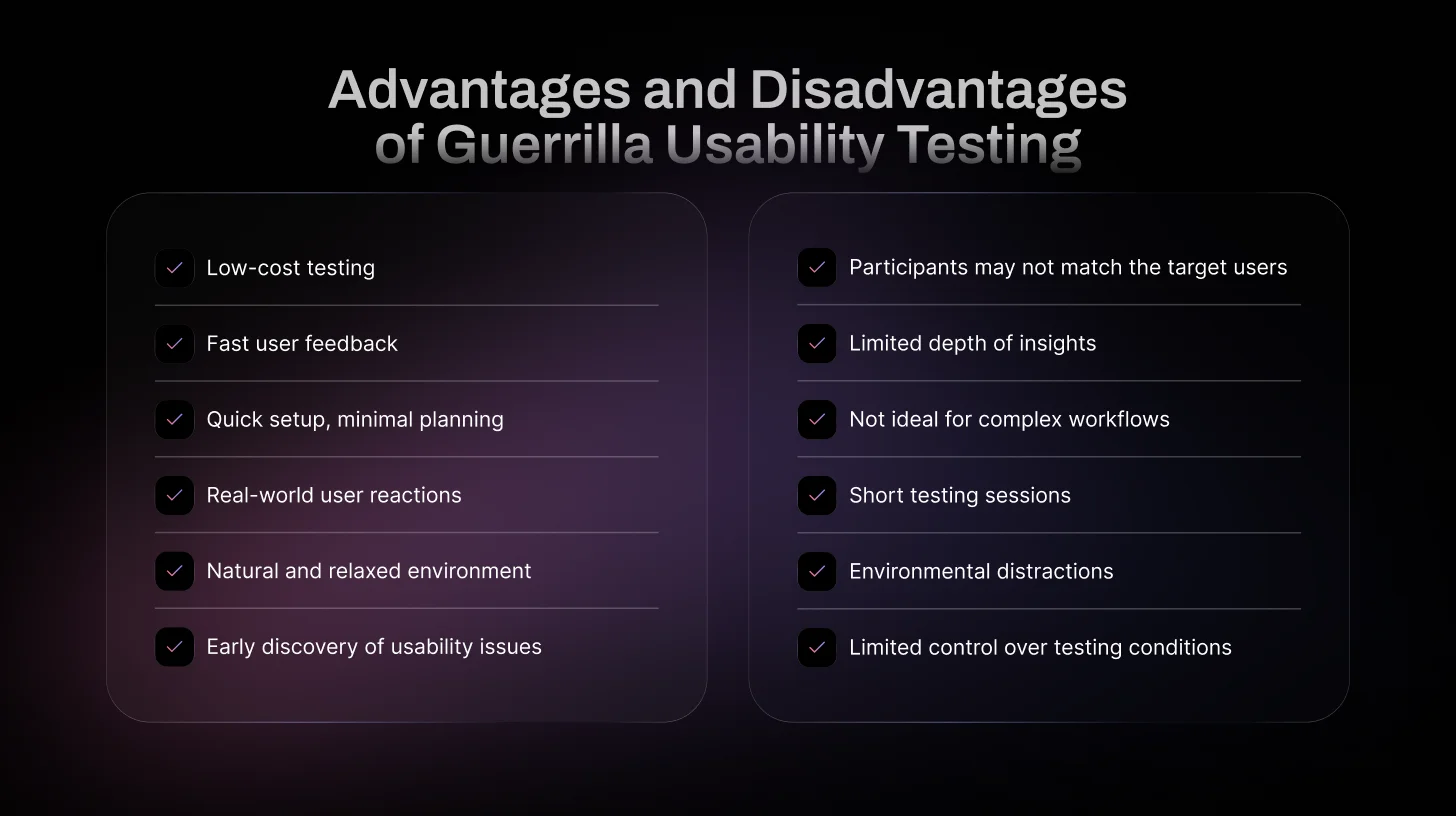
Despite its informal nature, guerrilla usability testing can provide valuable insights quickly and with minimal resources.
Low cost: Guerrilla usability testing usually requires very little budget compared to formal lab studies. A small incentive, such as a coffee or a gift card, is often enough to thank participants for their time.
Fast feedback: Because the setup is simple and planning is minimal, teams can start testing almost immediately. Insights can often be gathered within the same day, making this approach useful when deadlines are tight.
Real-world user reactions: Guerrilla testing typically takes place in an everyday environment. These natural settings help reveal how people interact with a product outside of a controlled research lab.
Relaxed testing atmosphere: The informal nature of guerrilla testing helps participants feel comfortable. Without the pressure of a formal study, people often speak more openly about confusion, frustrations, or unclear parts of the interface.
“The most valuable usability insights often come from watching someone use your product for the first time. Guerrilla testing captures that raw first impression before users adapt to the design.”
Disadvantages of Guerrilla Usability Testing
While guerrilla usability testing can provide quick insights, it also comes with limitations that teams should be aware of.
Participants may not represent your target users: People approached in public spaces may not match the product’s intended audience. Their feedback can still highlight usability issues, but may not fully reflect real customer needs.
Limited depth of insights: Short and informal sessions often reveal obvious usability problems but rarely uncover deeper behavioral motivations. The results should be treated as early signals rather than complete research findings.
Environmental distractions: Testing in cafes, malls, or other public locations means noise, interruptions, and background activity may affect participant focus during the session.
Limited control over the testing setup: Researchers cannot fully control factors such as devices, internet speed, or lighting conditions. These variables can introduce differences between sessions.
Methods of Guerrilla Usability Testing
Guerrilla usability testing can take different forms depending on where participants are found and how much time is available. Most methods focus on quick tasks that reveal usability issues within just a few minutes.
5-minute test
This is one of the simplest guerrilla testing methods. A participant is shown a design, prototype, or webpage for a few minutes and asked to complete a small task or describe what they understand from it. Because the session is short, it quickly reveals first impressions, confusion points, and whether the interface communicates clearly.
Cafe testing
A common approach is approaching people in cafes or coworking spaces and asking if they can spend a few minutes trying a product. Participants might be asked to complete a small task while sharing their thoughts out loud.
Campus testing
Universities and campuses provide access to many potential participants in one place. Students are often open to giving quick feedback on a website, prototype, or mobile app.
Public place testing
Guerrilla testing can also happen in places such as parks, malls, or libraries. These environments allow teams to quickly gather reactions from people with different backgrounds.
Online guerrilla testing
Not all guerrilla tests happen in person. Sometimes teams share a quick prototype link in online communities, forums, or social media groups where potential users already spend time.
Internal quick testing
In early stages, teams sometimes ask colleagues from other departments to try a product for a few minutes. While they may not be target users, they can still identify obvious usability problems quickly.
How to Conduct Guerrilla Usability Testing
Guerrilla usability testing may look spontaneous from the outside, but the best sessions still involve thoughtful preparation. A few small decisions, such as choosing the right tasks, selecting the right location, and approaching participants properly, can make a big difference in the quality of feedback you receive.
Below are several practical steps that can help teams run effective guerrilla usability tests.
Prepare the test before approaching participants
Even though guerrilla testing is lightweight, preparation still matters. Before speaking with participants, decide what you want to learn from the session.
Start by identifying the specific part of the product you want to evaluate. This could be a homepage, a sign-up flow, a checkout experience, or a new feature that has not been validated yet.
Next, think about the types of tasks participants should complete. The tasks should represent realistic user goals rather than instructions about where to click. A good task encourages exploration and allows you to observe how people interpret the interface.
For example, instead of saying:
“Click the pricing page and choose the Pro plan.”
You could frame the task more naturally:
“You are considering upgrading your account. How would you find information about pricing?”
Short tasks work best in guerrilla testing. Most participants will only spend a few minutes helping, so the entire session should typically last between five and ten minutes.
Use a prototype that feels close to a real product
Participants give better feedback when they interact with something that resembles an actual product experience.
The prototype you use will depend on the stage of the design process. Early concepts might involve low-fidelity wireframes, while later tests may use interactive prototypes or staging versions of a product.
What matters most is that participants can move through the flow naturally. If the experience feels too abstract or disconnected from real usage, people may struggle to understand how the product is supposed to work.
Even a simple interactive prototype can provide far more useful feedback than static screens.
Choose a location where people have time to talk
The location of a guerrilla test strongly influences the type of feedback you will receive.
Public places where people are relaxed and not in a hurry tend to work best. Coffee shops, university campuses, coworking spaces, and public libraries are common choices.
A helpful way to think about location is to imagine where your potential users might naturally spend time. If the product targets students, campuses are ideal. If the product focuses on professionals, coworking spaces or cafés near offices may work better.
The key is finding an environment where people are open to a short conversation.
Approach participants respectfully
Recruiting participants for guerrilla testing usually involves approaching people directly and asking if they would be willing to help.
Keep the request simple and honest. A short introduction works well, such as:
“Hi, I am working on improving a website and looking for quick feedback. Would you have five minutes to try something and share your thoughts?”
Many people are happy to help if the request feels genuine and the time commitment is small.
Offering a small incentive, such as buying someone a coffee or giving a small gift card, can also make people more willing to participate.
Encourage participants to think aloud
During the session, observation is more important than explanation. Try to avoid guiding participants too much, since that can influence their behavior.
Instead, encourage them to describe what they are thinking while completing the task. Hearing someone talk through their decisions can reveal where expectations do not match the design.
For example, participants might say things like:
- “I expected this button to take me somewhere else.”
- “I am not sure what this page is supposed to do.”
- “I thought the pricing would be here.”
Moments like these often point to usability issues that are easy to miss during internal design reviews.
Ask follow-up questions after the task
Once the task is finished, spend a minute asking a few open-ended questions about the experience.
These questions can help clarify what the participant was thinking during the test. Examples might include:
- What part of the task felt confusing?
- Was anything harder than expected?
- What would you change about this page?
Keep the conversation short. The goal is not to conduct a full interview, but to capture quick impressions while the experience is still fresh.
Look for patterns across participants
After several sessions, review your notes and look for repeated behaviors.
If multiple people hesitate at the same moment or misunderstand the same feature, that usually signals a usability problem rather than an isolated mistake.
Guerrilla usability testing often involves small groups of participants, but even a handful of sessions can reveal the most critical usability issues.
Iterate and test again
One of the biggest advantages of guerrilla testing is that it can be repeated easily.
Once problems are identified, teams can adjust the design and run another quick round of testing to see whether the changes improved the experience.
Over time, this rapid cycle of testing and iteration can significantly improve usability without requiring large research budgets or long timelines.
Validate your product ideas faster
Run quick usability tests, talk to real users, and turn feedback into actionable insights with TheySaid.
Try TheySaid for free
FAQs
What is the purpose of guerrilla usability testing?
The purpose of guerrilla usability testing is to quickly uncover usability problems and understand how real users interact with a product. It helps teams validate ideas early, improve designs faster, and avoid building features that are confusing for users.
Where can guerrilla usability testing be conducted?
Guerrilla usability testing is often conducted in places where people have a few minutes to spare, such as cafés, university campuses, coworking spaces, libraries, or public areas. Some teams also run quick guerrilla tests online through communities or forums.
How do you conduct guerrilla usability testing?
To conduct guerrilla usability testing, start by preparing a small set of realistic tasks for participants. Then approach people in places like cafés, campuses, or coworking spaces and ask if they can spend a few minutes trying your product or prototype. Observe how they complete the tasks, encourage them to think aloud, and take notes on usability issues you notice.
Why is guerrilla usability testing effective?
Guerrilla usability testing is effective because it provides quick feedback from people who have never seen the product before. This fresh perspective often reveals usability problems that internal teams may overlook after spending too much time with the design.
Is guerrilla testing the same as intercept testing?
No, they are not the same, although both involve collecting quick feedback from people.
Guerrilla testing involves approaching random people in public places and asking them to try a product or prototype for a few minutes. Intercept testing involves asking people who are already interacting with a product, website, or environment for quick feedback.


.svg)


