




AI has made it faster than ever to generate ideas, prototype, and ship. The hard part isn't moving fast anymore; it's staying confident while you do. Here's the checklist that keeps both intact.
The Real Problem
Speed went up. Confidence didn't follow.
There's a strange tension inside product teams right now. AI tools have compressed weeks of work into hours. A designer can explore 30 directions before lunch. A developer can prototype three flows before standup ends. The output has never been higher.
But here's the thing nobody talks about enough: more options don't mean better decisions. When generation is instant, the bottleneck shifts from producing to judging. And judgment is still very much a human problem.
The teams moving fastest with the least regret aren't skipping validation. They've changed what validation looks like: faster, lighter, embedded in the workflow rather than scheduled as a separate phase. That's what this checklist is built for.
When everyone can generate anything instantly, knowing what's actually right becomes the rarest skill on the team.
Phase 01: Before You Start — Align on the Problem First
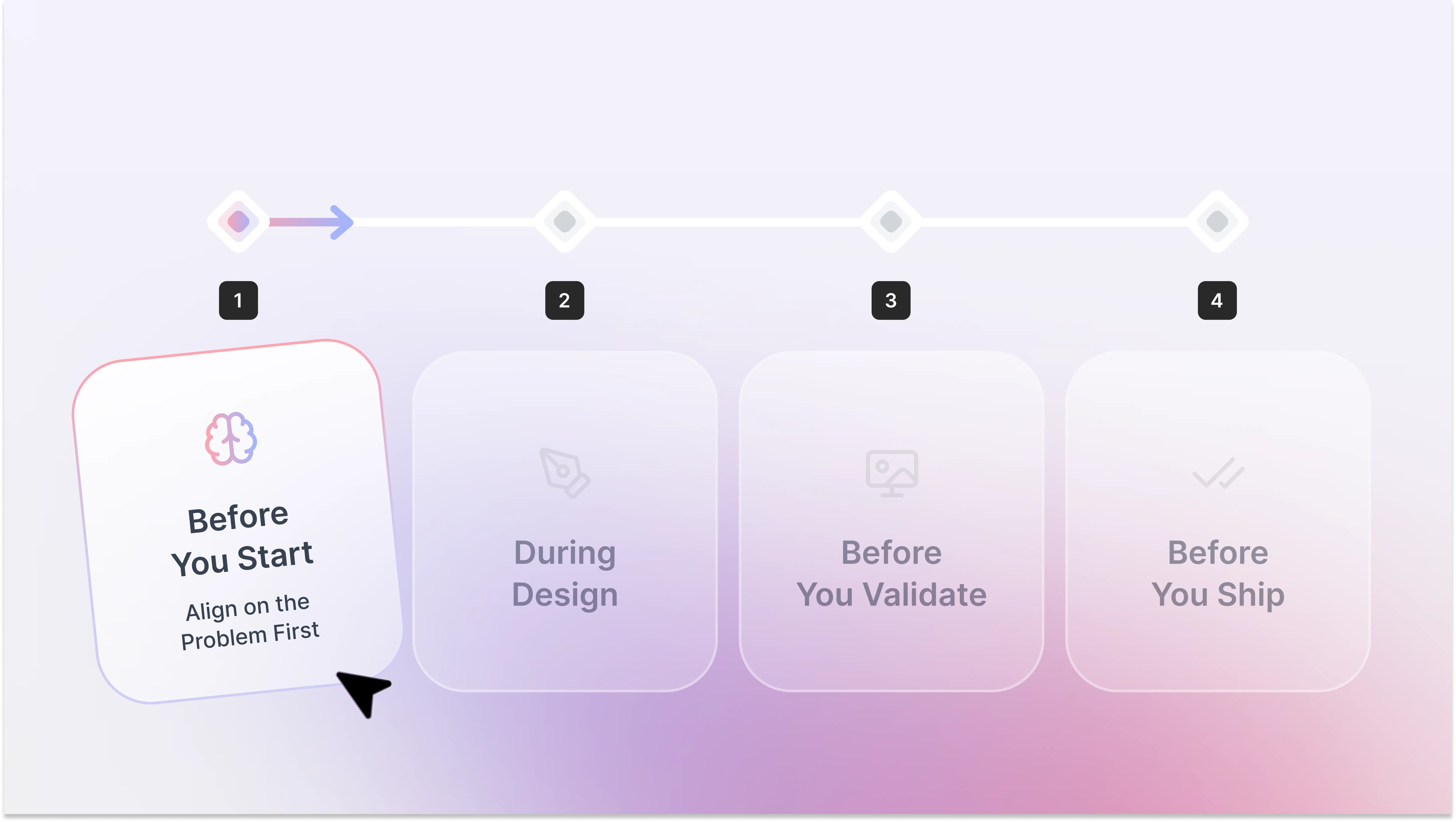
The most expensive mistake in product development isn't bad design. It's a great design solving the wrong problem. Before any UI, any prototype, any variation, run through these.
Can everyone on the team state the problem in one sentence?
If PMs, designers, and researchers give different answers, you're not ready to design yet. Hidden disagreement at this stage produces designs that try to solve every interpretation at once and solve none of them clearly.
Do you know whose problem this actually is?
Not a persona document. A real type of user with a real behavior you've observed. The more specific you can get here, the more useful every design decision downstream becomes.
Have you validated the direction, not the design?
Concept validation is faster and cheaper than design validation. Get a signal on whether the idea solves the right problem before investing in how it looks. A quick AI-moderated session with real users can give you directional clarity the same day you identify the question.
Is discovery built into your workflow or still treated as a phase?
The biggest shift in how modern teams operate: customer feedback is a weekly habit, not a project milestone. If research only happens before and after a build cycle, you're always working on yesterday's insight.
Phase 02: During Design — Stay Grounded as Options Multiply
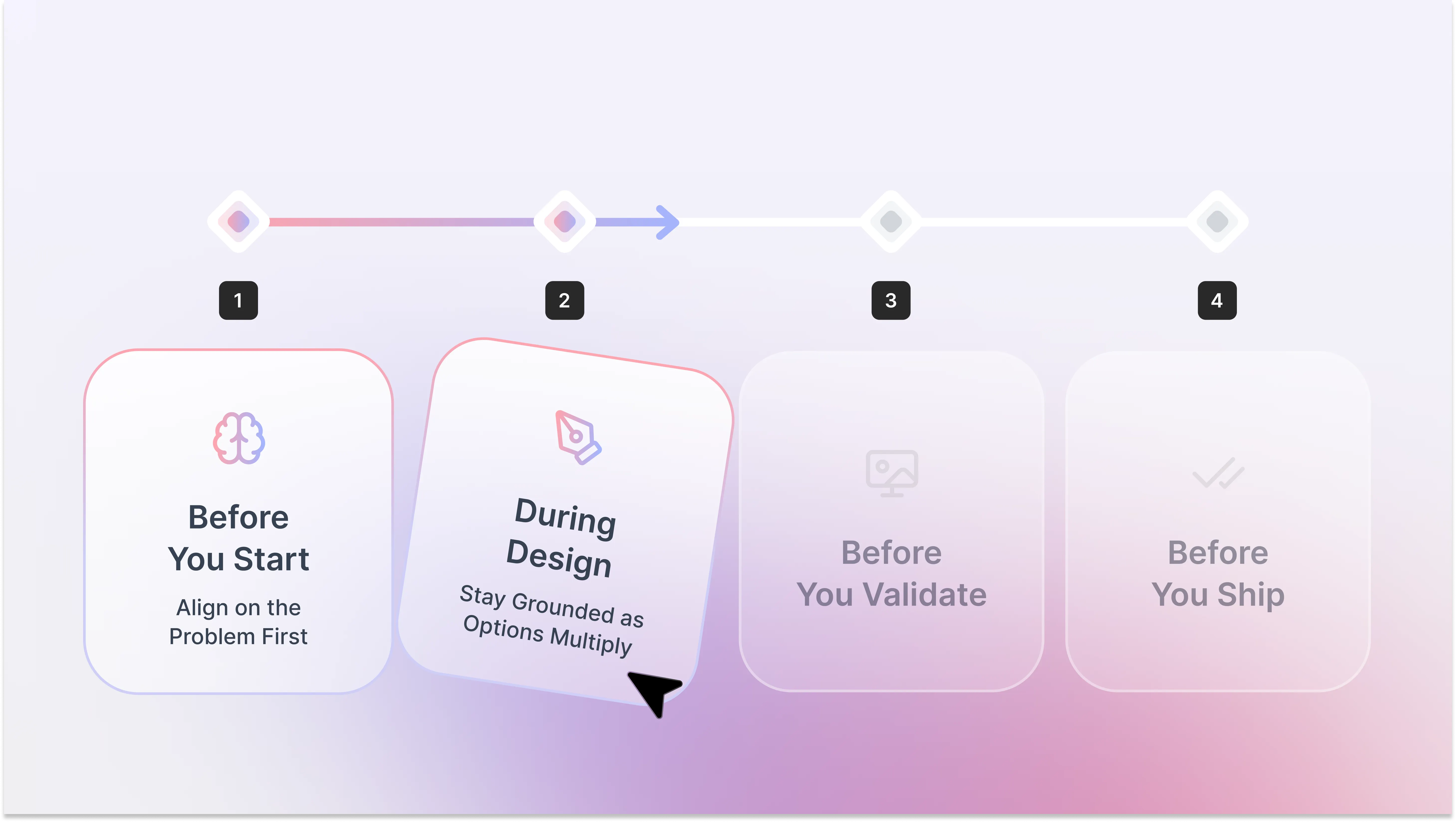
AI expands the option space fast. That's the opportunity and the trap. More options mean more decisions about which options actually matter.
Is this decision reversible or irreversible?
Changing a CTA label is a two-minute fix. Committing to a navigation architecture is a six-month undertaking. Apply different levels of validation to each. Reversible things can be shipped and watched. Irreversible things need a real signal before you commit.
What assumption is this design built on?
Name it explicitly. If you can't, the decision isn't ready to be made. This is the most common gap: teams ship with confidence because the design looks polished, not because the underlying assumption has been tested.
Are you generating to explore or generating to avoid deciding?
There's a meaningful difference. AI-generated options can create the illusion of progress without the team ever making an actual call. More variations are not the same as more clarity.
Have you narrowed it with real user signal, not just team opinion?
AI is remarkable at expanding what's possible. It can't tell you what's right. Use generation to get to the right questions faster, then answer those questions with actual users.
Are design systems in place to maintain quality as more people build?
When prototyping is no longer just a design team activity, quality guardrails become infrastructure. Without them, speed scales. Standards don't.
Watch out for false confidence from high-fidelity prototypes.
When something looks and feels real, teams and stakeholders start treating it as validated. High fidelity creates emotional resonance. That resonance still has to connect back to real user goals, or it's just a convincing fiction.
Phase 03: Before You Validate — Know What You're Actually Testing
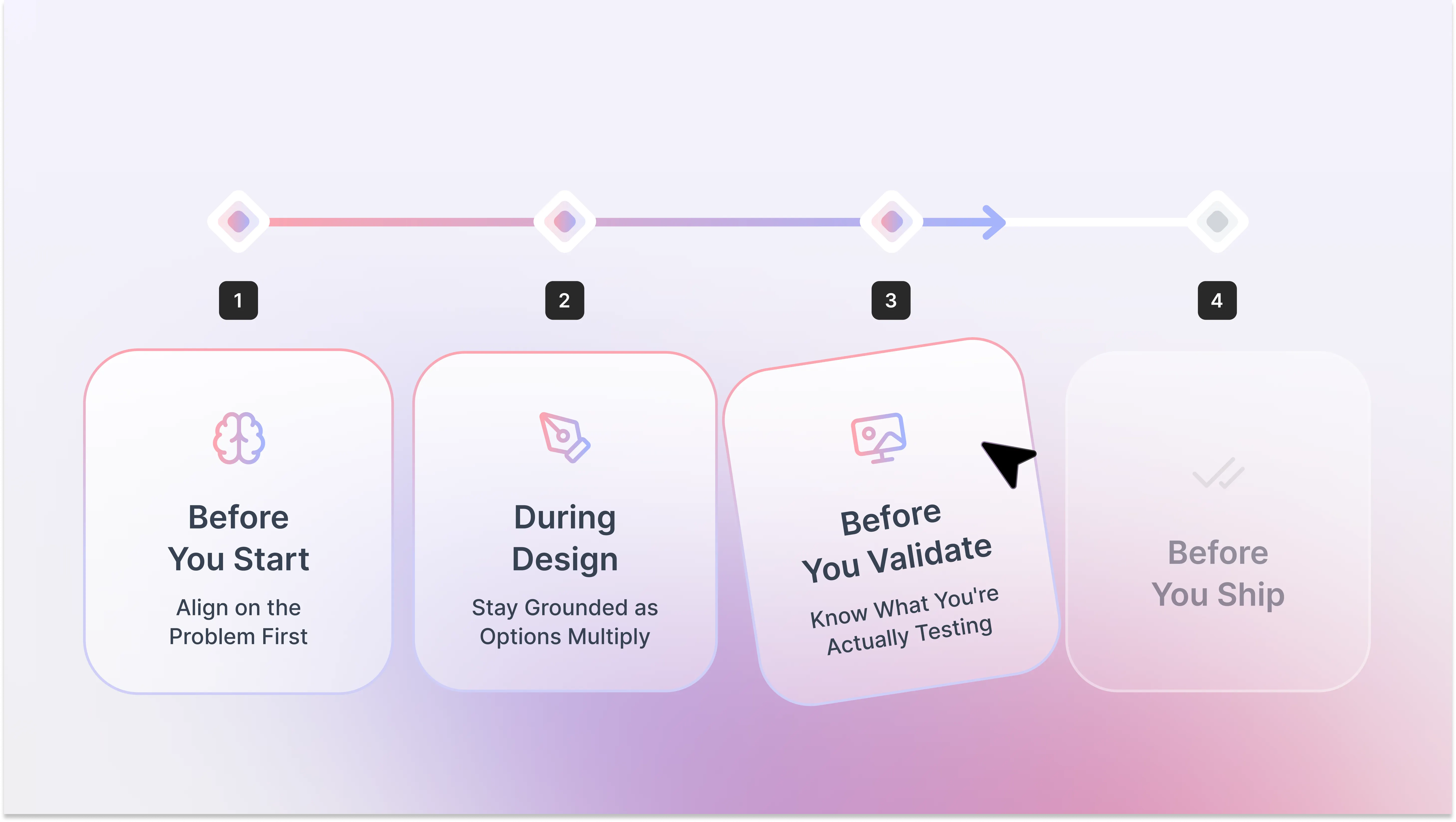
Running research without a clear question is the fastest way to get data that doesn't drive decisions. Research that arrives after the decision has already been made is archaeology, not insight.
What would change your mind based on what you learn?
If the answer is "nothing," you're confirming, not validating. The teams that move fast with confidence test because they assume they're wrong, not to prove they're right.
Are you testing the concept or the execution?
These need different methods and different questions. Testing a concept: Does this idea solve the right problem? Testing execution: can users actually use this? Conflating the two gives you muddled results that don't drive clear action.
How much signal do you actually need?
A well-structured session with five to eight users can surface the major directional issues. You don't always need statistical significance to move. The goal is enough signal to make a confident call not a comprehensive research report.
Will findings reach decision-makers fast enough to matter?
Insight embedded in the workflow beats insight living in a separate deck. If findings need a presentation to land, they're already competing with decisions that have moved on without them.
Is AI handling synthesis or replacing understanding?
AI can accelerate the operational side of research dramatically: summarizing sessions, flagging patterns, and generating next steps. What it can't do is tell you what those patterns mean for your specific users in your specific context. Humans still own meaning, impact, and decisions.
Phase 04: Before You Ship — The Final Gut-Check
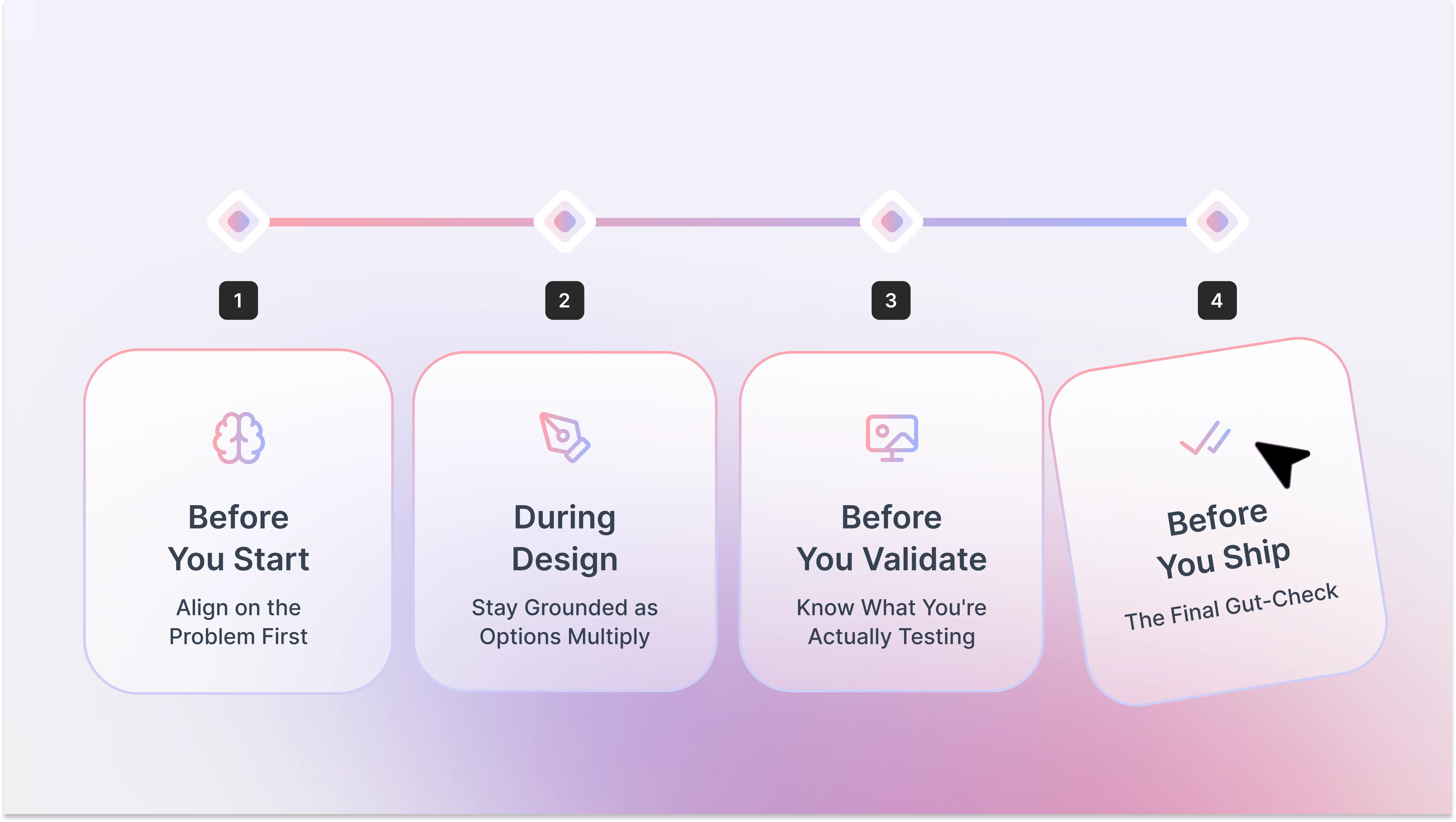
This is where most teams skip the last step. Confidence peaks during exploration and drops right before ship — exactly when this check matters most.
Can you explain why this is right, not just why it looks good?
It tested well" is a start. "It reduced friction at this specific point because users were confused about X" is defensible. The difference matters when stakeholders push back or a decision needs to be revisited six months later.
Has the internal disagreement been surfaced, not designed around?
If nobody pushed back, either the decision is bulletproof or nobody felt safe saying so. The fastest-moving teams build rituals where disagreement surfaces early and gets tested — rather than building elaborate designs that paper over it.
Is this being driven by data or by the loudest voice in the room?
The HiPPO problem — decisions driven by the Highest Paid Person's Opinion is the most persistent threat to good design calls. Real user insight, visible and embedded in the workflow, is the most effective counter to it.
Do you know how you'll measure whether this worked?
Define success before you ship, not after. Without a pre-defined signal, you can't learn from the outcome — fast or slow.
Is there a rollback plan if you're wrong?
Confidence and contingency aren't opposites. Knowing what you'll do if this doesn't work is part of making a good decision — not an admission of doubt.
The Underlying Shift
The teams winning aren't moving faster. They're making better bets.
AI hasn't made research less important. It's made fast research more important. The teams staying confident at speed have replaced the research phase with a research habit, smaller, more frequent, embedded in the workflow rather than scheduled around it.
The boxes on this checklist you can't check aren't problems with your process. They're the decisions that need more work before they ship. That's the whole point not to slow you down, but to make sure that when you move fast, you're moving in the right direction.
Speed compounds. So does being wrong.
Get user signal at the pace your team moves.
TheySaid runs AI-moderated user tests, intelligent surveys, and automated interviews so you go from question to insight in hours, not weeks.
Try TheySaid free →


.svg)


