



Your team can build a working prototype in an afternoon now. Getting real feedback on it still takes days, sometimes weeks, because the testing workflow underneath most tools hasn't actually caught up to the build speed.
So "does this tool use AI" is the wrong question. The question that actually separates these platforms is where the AI sits: does it run the session, does it adapt to a participant in real time, or does it only show up afterward to summarize a recording someone else made?
This guide breaks down the AI capabilities of TheySaid, UserTesting, Maze, Outset, and Listen Labs, so you can see what each platform actually does with AI before you commit a research budget to one.
TL;DR
Not every "AI-powered" testing tool uses AI the same way. TheySaid, Maze, Outset, and Listen Labs all run AI that moderates a live session, asking real follow-up questions as a participant works or talks. UserTesting's AI, by contrast, goes to work only after a human-run or fixed-script session ends. This guide compares the AI capabilities, real limitations, pricing, and testing workflows of five leading platforms so you know which kind of "AI-powered" you're actually buying.
Related: For a broader side-by-side of features, panels, and pricing across the tools, read 10 Best AI User Testing Tools in 2026.
Comparing AI Capabilities of the Top User Testing Tools
TheySaid: The Only Full-Stack AI Moderator, Free to Start
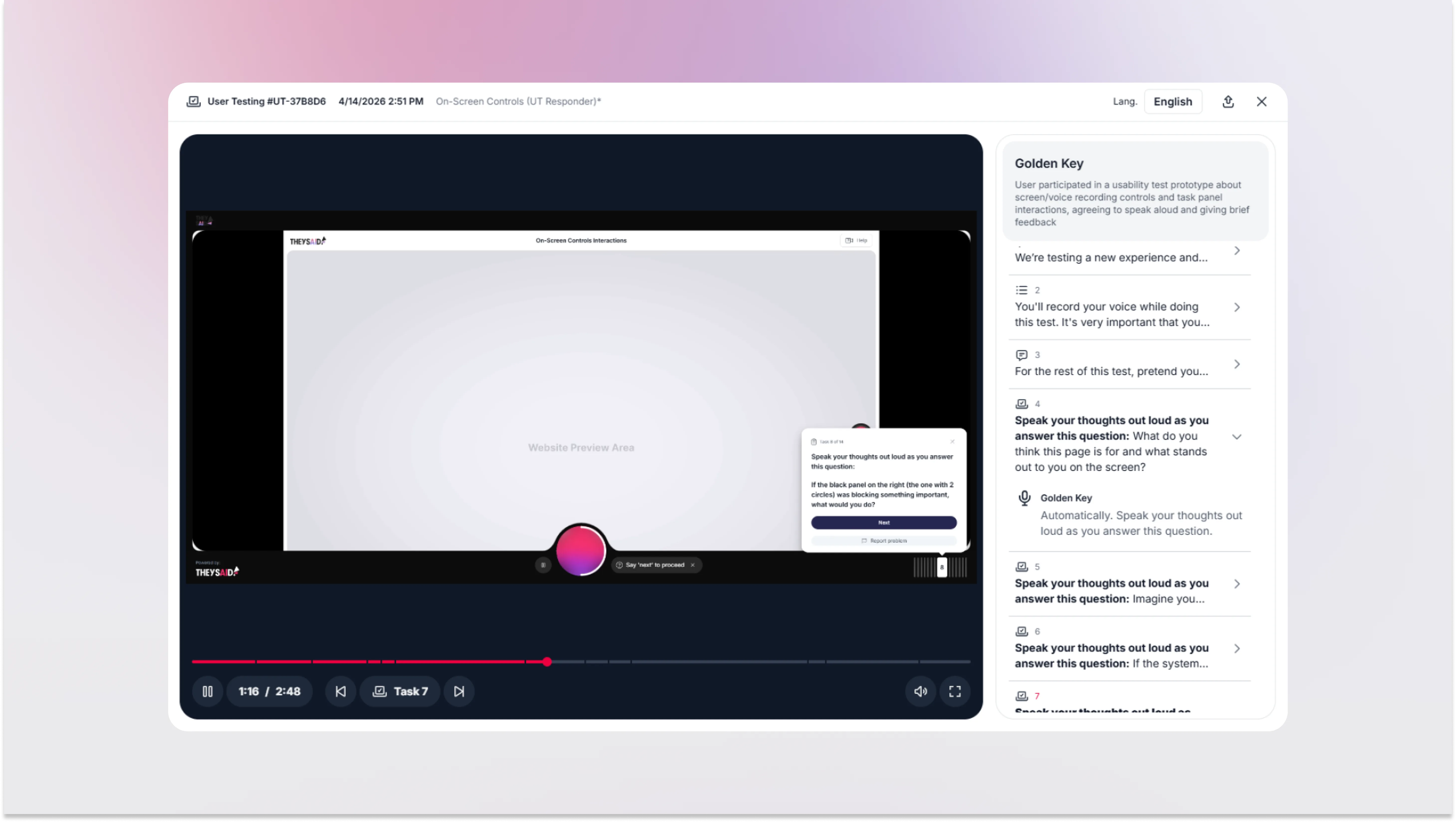
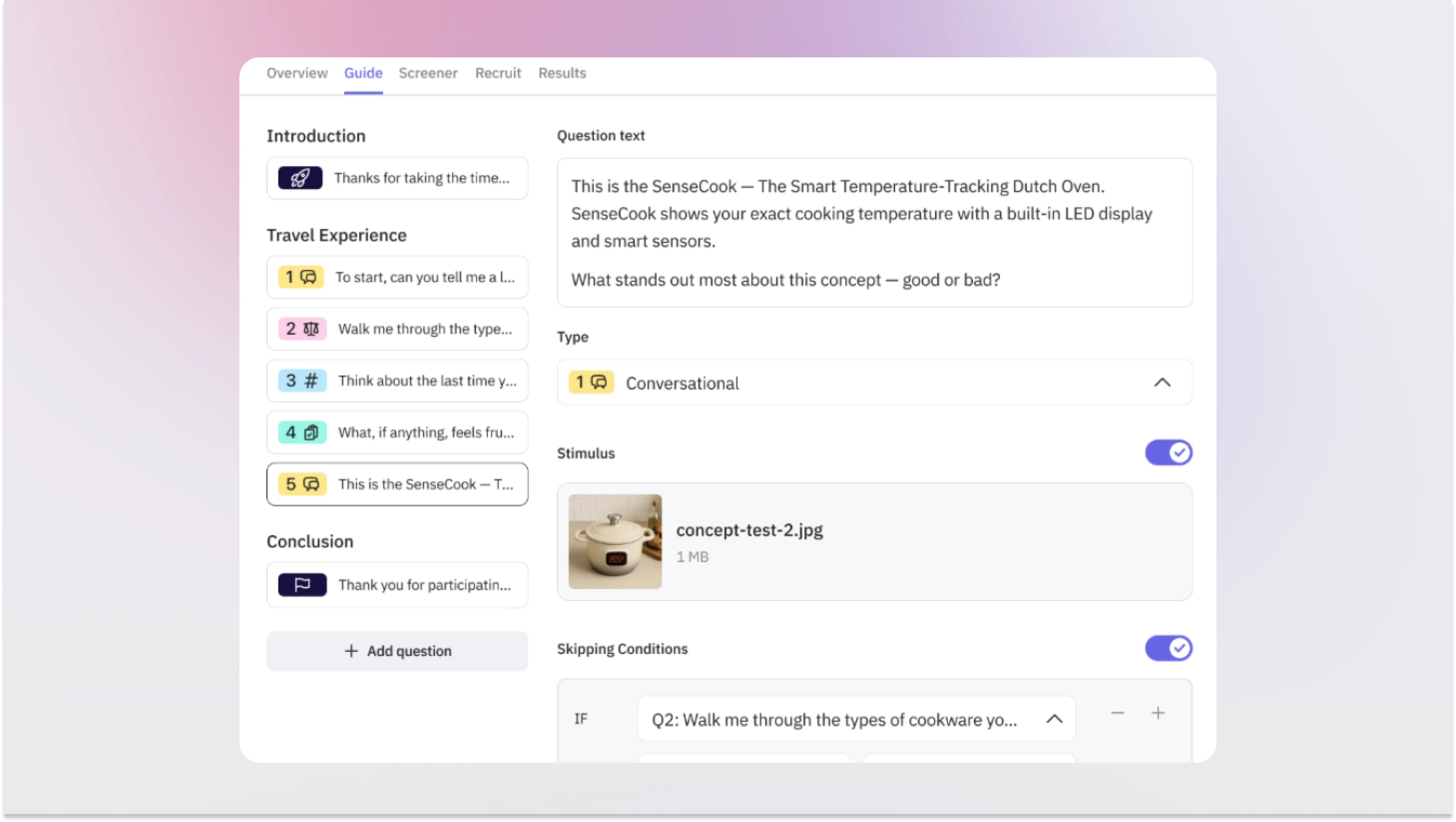
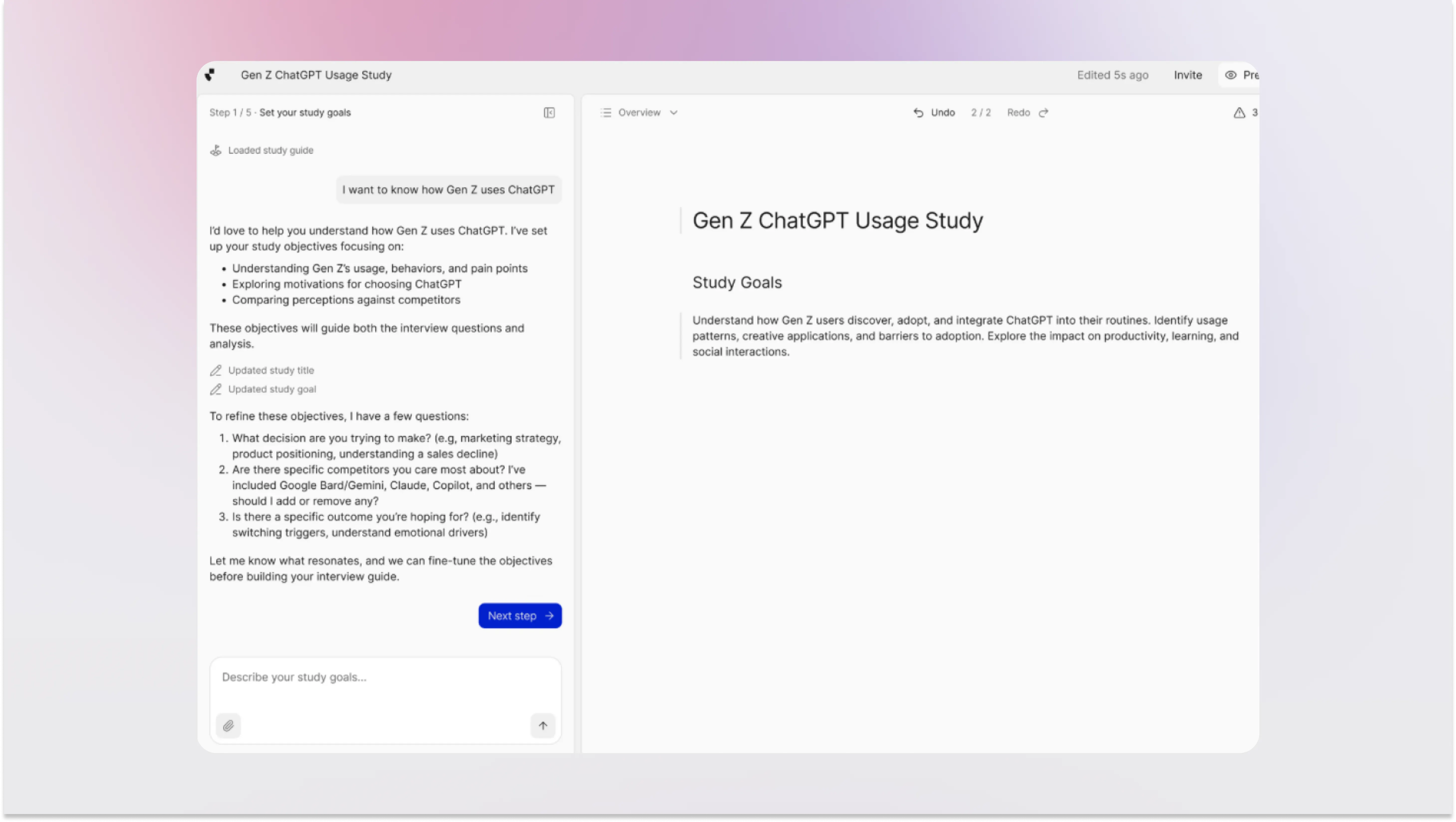
TheySaid’s AI runs the entire loop, not one stage of it. The AI project creator scopes the test, the AI test moderator runs it guiding participants through tasks while asking intelligent follow-up questions the moment it detects confusion or frustration, and the AI analytics and reporting layer synthesizes results the moment the session ends. Nobody on your team watches a recording or scrubs a transcript for themes.
Most “AI-powered” testing tools split the job in two: a human or a fixed script runs the session, and AI only shows up afterward to summarize it. TheySaid’s moderator is live in the session itself, capturing screen activity and voice feedback while moderating in real time, across 70+ languages.
The pricing detail worth underlining: this isn’t held back for an enterprise tier. TheySaid’s free plan includes the AI project creator, AI moderation, and AI analytics the same AI stack a paying enterprise customer gets, just with lower usage caps. Compare that to Maze’s AI Moderator (an Enterprise add-on) or Listen Labs’ managed, scoped engagement model, and TheySaid is the only platform in this comparison where the AI itself isn’t the upsell.
Two newer additions push TheySaid past pure usability testing into validation across the whole product build process. Synthetic Testers are custom AI testers that behave like real customers; they follow instructions, share their screen, and speak their reactions aloud like a synthetic persona, which makes them useful for a first pass before you recruit real participants, not a replacement for them. TheySaid MCP goes a step further: it plugs directly into the AI tools teams are already using to build Lovable, v0, Replit, Bolt, and Claude Design so you can pull instant feedback and fix prompts on a prototype without leaving the build tool. None of the other four platforms in this comparison offer either capability today.
Where TheySaid falls short: Synthetic Testers and the MCP build-tool integration are newly launched, so there’s less independent, third-party review data on them yet than on more established competitor features worth a firsthand test before betting a whole workflow on them. And because the whole platform assumes AI-first moderation, teams coming from a fully manual, human-run research process have a short adjustment curve trusting an AI-run session at first.
UserTesting: Real AI, but It Analyzes, It Doesn't Moderate
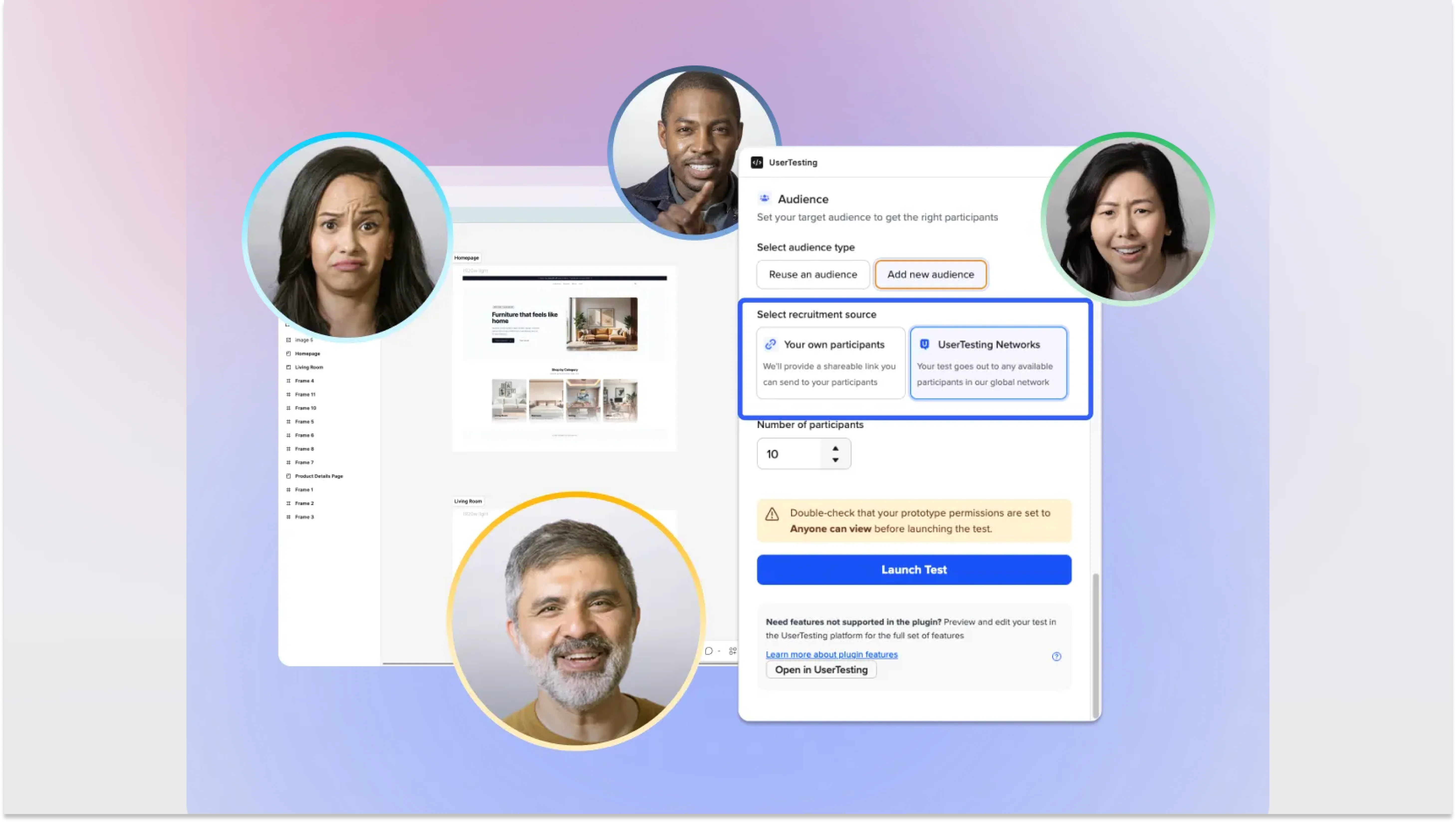
UserTesting's AI investment is genuine and well-documented on its own site: AI Insight Summary uses an LLM to synthesize verbal and behavioral data across sessions, sentiment and intent analysis flags friction automatically by cross-referencing behaviors like rage-clicking with what participants say out loud, and interactive Path Flows turn clickstream data into visual journey maps.
What none of that changes is who runs the session. UserTesting's moderated option — Live Conversations — is still moderated by a human. The AI's job starts once the recording exists: finding the moment, the sentiment, the theme. That's real value on a large study with dozens of sessions to review. It's a different job from an AI that decides, mid-session, what to ask next.
Where UserTesting falls short on AI specifically: every AI feature here operates on data a human already collected. If the goal is AI that adapts the next question live, this isn't that product yet — and UserTesting's enterprise contract pricing, commonly reported to start between $25,000 and $35,000 a year, puts even the analysis-only version out of reach for smaller teams.
Maze: The Most Feature-Complete AI Moderator, Locked to Enterprise
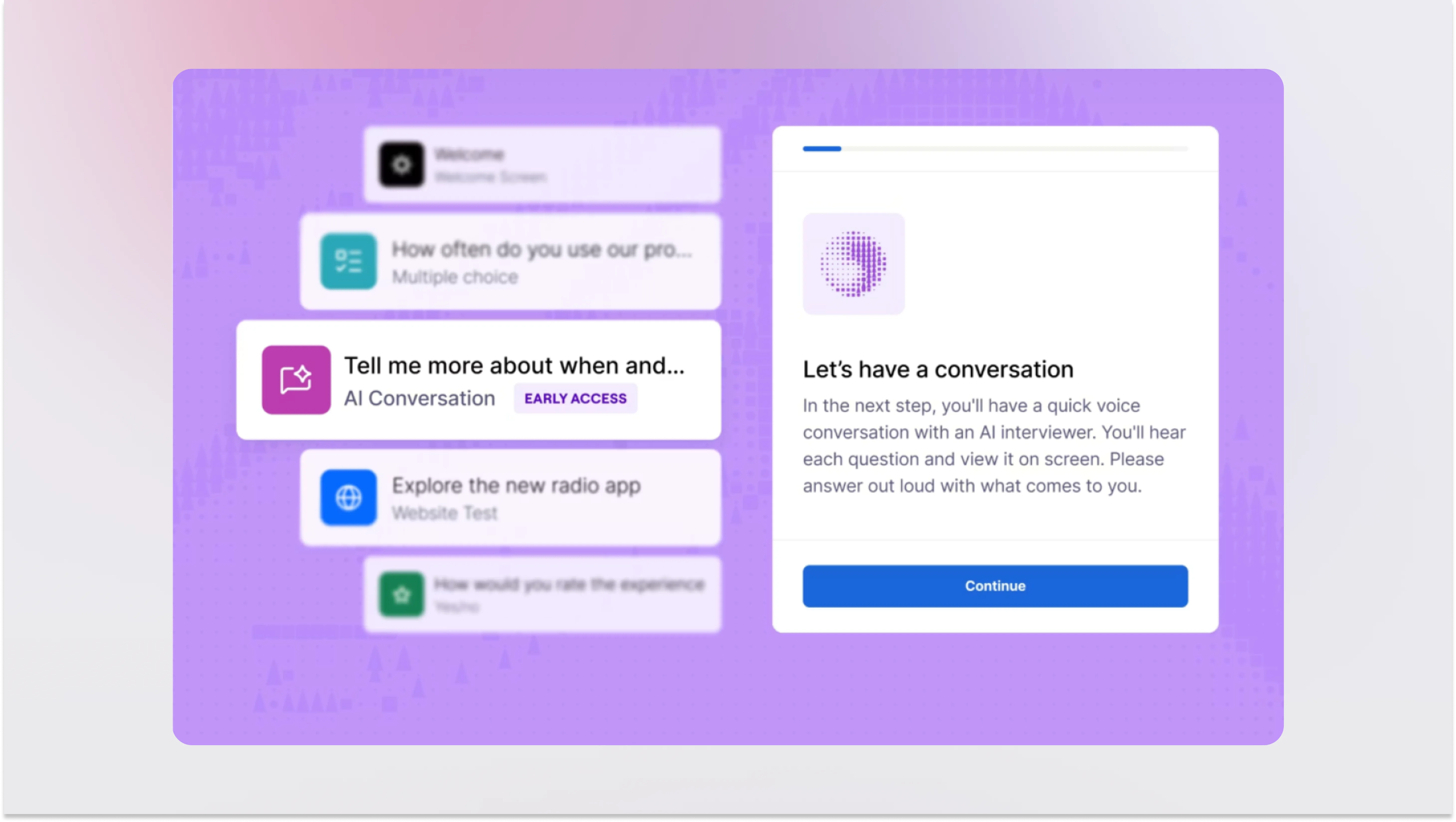
Maze's own AI documentation describes the most fully built-out AI moderator of any competitor here. The AI Study Builder turns a plain-language research goal into a structured study — methodology, questions, and settings included. From there, the AI moderator runs interviews around the clock, rephrasing and probing based on participant responses, and every conversation is checked against 25 quality metrics designed to catch leading or biased questions before they skew results.
The catch is exactly where Maze's own pricing page puts it: the AI moderator is an add-on available only with Enterprise plans, and buyer-reported figures put that add-on near $15,000 a year, separate from panel recruitment costs. The free and mid tiers keep Maze's original strength — fast, unmoderated Figma prototype testing — but the AI capability this comparison is measuring sits behind that Enterprise wall.
Where Maze falls short on AI specifically: the most sophisticated AI feature set on this list is priced for teams that already have an enterprise research budget, a smaller overlap than Maze's "fast, affordable" reputation suggests.
Outset: Deep AI Conversation, Built for Interviews More Than Usability Testing
Outset runs genuine AI moderation rather than after-the-fact analysis. Its AI conducts the interview itself text, voice, or video- across 40+ languages, capturing recordings and analyzing responses as the conversation happens, then letting a researcher query the resulting data directly instead of reading a full transcript.
The detail worth knowing before comparing it to TheySaid or Maze: Outset's probing follows a question track the researcher configures ahead of time, at a set depth, rather than adapting as freely session-to-session. That's a deliberate trade-off: it produces more standardized, comparable output across a large sample, at the cost of some spontaneity. Outset is also built primarily around interview-style research (personas, concept testing, brand research) rather than click-based usability testing, and there's no built-in participant panel — recruitment is entirely bring-your-own.
Where Outset falls short: no included panel means sourcing participants is your job, and at roughly $20,000 per seat per year plus usage billing, it's built for research teams with dedicated budget, not a PM running a quick usability check between sprints.
Listen Labs: Deep AI-Moderated Interviews, but Only Through a Managed Engagement
Listen Labs runs genuine live AI moderation, too; its AI conducts the interview directly, in voice, video, or text, across 100+ languages and 45-plus countries, asking real-time follow-up questions the way TheySaid, Maze, and Outset do. On the AI itself, it's a legitimate peer to those three, not an analysis-only tool like UserTesting.
What makes Listen Labs different is how you get to that AI. There's no self-serve signup. Every engagement starts with a scoping conversation, an audience-definition exercise, and a contracting cycle through procurement, and Listen Labs' own recruitment ops team sources and screens participants from its 30 million-plus panel on your behalf, rather than you publishing a project yourself. Once a study is live, its Mission Control layer supports cross-study queries and trend tracking within a program, and rich-media stimuli testing (Figma prototypes, images, video) is a real strength for concept and prototype validation.
That managed model is also the cost structure. Pricing isn't published, but third-party sources converge on roughly a $20,000-a-year base, plus per-session panel costs on top (commonly cited in the $85–$400-per-completed-interview range depending on audience complexity) — before your first interview runs, not after.
Where Listen Labs falls short on AI specifically: the AI moderation itself is genuinely deep, but it's gated behind a sales-led engagement rather than something a PM can spin up the same afternoon. And Listen Labs doesn't offer a standalone survey, poll, or form product; the platform is built around interviews and stimuli testing, not the broader research toolkit some of the other platforms here cover.
How to Evaluate Any AI User Testing Tool Yourself
If a new tool shows up next year claiming "AI-powered," here's the checklist that cuts through the marketing:
Ask who asks the second question. If a human designed every question in advance and the AI only shows up afterward, that's analysis, not moderation a legitimate capability, just not the one "AI-moderated" implies.
Ask where the AI sits on the pricing page, not the homepage. As this guide shows, the homepage and the pricing page often tell two different stories — several vendors here advertise AI moderation prominently while gating it behind an enterprise tier or a sales-led engagement.
Ask what happens with a confused participant. Real-time adaptation to hesitation, confusion, or an unexpected answer is the clearest tell of genuine moderation versus a fixed script with an AI summary bolted on afterward.
Ask what "quality safeguard" actually means. Maze publishes a specific 25-point check; others describe safeguards more vaguely. A vendor that can name its own guardrails against biased or leading AI questions is usually further along than one that can't.
Ask what it takes to start, not just what the AI can do. Genuine AI moderation isn't the only variable. Listen Labs' AI is a real peer to TheySaid's and Maze's, but reaching it means a scoping call and a contract first. If speed to first insight matters as much as depth, that's a separate question worth asking directly.
The sample-size assumption still applies. AI changes how fast you get through participants, not how many you need for confidence. The Nielsen Norman Group's own research on usability sample sizes still holds regardless of which platform runs the session, since it's about the underlying statistics of problem discovery, not the moderation method.
Choose Your Tool
Match the tool to the job: usability testing, discovery interviews, or quick design validation.
Choose TheySaid if…
- You want AI that moderates the session live, not just summarizes it afterward without paying enterprise rates or booking a sales call to unlock that capability.
- You need testing, moderation, and instant synthesis in a single flow, on a free plan, without a dedicated researcher to run it.
- You're testing usability and product experience specifically, not just running discovery interviews.
Choose UserTesting if…
- You're a large enterprise with a six-figure research budget and a dedicated UX team running human-moderated video sessions.
- The AI's job, in your workflow, is to speed up analysis after a human already ran the study, not to run it.
Choose Maze if…
- Native Figma prototype testing inside a design sprint is your core, everyday need.
- You can justify Enterprise pricing specifically to unlock the AI moderator; otherwise, you're paying for Maze's unmoderated strengths, not its AI.
Choose Outset if…
- Your research is interview-style motivations, willingness to pay, open-ended discovery rather than click-based usability testing.
- You have both the budget and your own participant pipeline, and want standardized, comparable AI-moderated transcripts across a large sample.
Choose Listen Labs if…
- Sourcing rare or hard-to-find participants is your actual bottleneck, and you'd rather hand recruitment to a dedicated team than run it yourself.
- A scoped, sales-led engagement fits how your organization already procures research, and interviews are close to your whole research program.
Frequently Asked Questions
Which user testing tool has AI that moderates sessions live, not just afterward?
Four platforms in this comparison run AI that asks adaptive follow-up questions during the session itself: TheySaid, Maze, Outset, and Listen Labs. UserTesting uses AI only for after-the-fact analysis — a human or a fixed script still runs the actual test.
What's the real difference between "AI-moderated" and "AI-assisted" user testing?
AI-moderated testing (TheySaid, Maze, Outset, Listen Labs) means the AI itself asks the next question in real time, adapting to what a specific participant just said or did. AI-assisted testing (UserTesting) means a human designs and runs the actual session, and AI's role starts afterward — summarizing themes, sentiment, or patterns from data someone else already collected.
Is Maze's AI moderator available on every plan?
No. Maze's free and mid tiers cover its original strength — unmoderated prototype and usability testing. The AI moderator, which conducts adaptive interviews, is an add-on available only with Enterprise plans, priced separately from panel recruitment.
Does Listen Labs' AI moderation work the same way as TheySaid's or Maze's?
The AI itself is comparable — live, adaptive, real follow-up questions. The difference is access. TheySaid and Maze (on the right plan) let you launch a project yourself. Listen Labs runs its AI-moderated interviews through a managed engagement: a scoping call, a contract, and its own recruitment team sourcing participants before your study runs.
Can a small team access real AI moderation without enterprise pricing or a sales call?
Yes — and this is one of the sharpest differences in this comparison. TheySaid includes live AI moderation on its free plan. Maze gates the equivalent capability behind an Enterprise add-on estimated near $15,000 a year, Outset's per-seat pricing runs closer to $20,000 a year, and Listen Labs' managed engagement is cited at a similar $20,000-plus annual base, with per-session panel costs added on top. If budget or speed-to-start is the deciding factor, not every "AI-moderated" platform is priced or accessed the same way.
Do any of these tools use synthetic AI participants instead of real users?
Yes — TheySaid's Synthetic Testers are custom AI personas that follow instructions, share their screen, and speak their reactions aloud, similar to a synthetic persona. They're positioned for a fast first pass before recruiting real users, not as a full replacement for real feedback. None of the other four platforms in this comparison currently offer a synthetic-tester feature as part of their core AI toolset.
Can I get AI feedback directly inside a prototype-building tool like Lovable or v0?
With TheySaid, yes. TheySaid MCP connects directly to AI build tools including Lovable, v0, Replit, Bolt, and Claude Design, so you can pull feedback and fix prompts on a prototype without leaving the tool you built it in. This is a newer capability, and none of the other four platforms in this comparison offer an equivalent integration yet.
Does using an AI moderator mean I need fewer test participants?
No, AI changes the speed and cost of running sessions, not the underlying statistics of how many participants it takes to surface most usability problems. That's a separate, well-established research question tied to sample size and method, not moderation type.
Can AI user testing replace a human UX researcher?
No, and none of the vendors in this comparison claim otherwise on their own sites. AI removes repetitive work — scheduling, transcribing, first-pass theming — but interpreting why a finding matters for the roadmap, and deciding what to build next, is still a human judgment call.
Is my data safe with an AI user testing tool?
This is worth checking per vendor rather than assuming. Ask specifically whether session recordings and transcripts are used to train the vendor's AI models, whether data is shared with third-party model providers, and what your participant consent language needs to cover as a result. TheySaid, UserTesting, Maze, Outset, and Listen Labs all publish compliance details (SOC 2, GDPR, and similar) on their security or trust pages — read the actual data processing agreement before assuming "AI-powered" and "your data trains our model" mean the same thing, because they don't always.
Is AI-generated analysis (summaries, themes, sentiment) accurate enough to trust on its own?
Every vendor in this comparison that offers AI synthesis — TheySaid, UserTesting, Maze, Outset, Listen Labs — still recommends a researcher spot-check findings against the source recordings or transcripts, especially for high-stakes decisions. Treat AI synthesis as a fast first pass that surfaces patterns, not a final report you skip reading.


.svg)


