




Market research surveys are a key to understanding your target audience. They provide useful insights into the market landscape, customer behavior, and preferences to make informed decisions.
However, crafting an effective survey can feel overwhelming. Where to begin?
How can we ensure our approach is efficient? And most importantly, how can we transform feedback into actionable data?
The answer lies in understanding the concept of market research and following a proven research process for success.
This blog is your ultimate guide to understanding market research surveys, their impact on transforming business dynamics, the various types available, and a step-by-step process for creating a market research survey. We’ll also explore how AI is revolutionizing how businesses conduct and analyze market research.
Let’s get started!
TL;DR
A market research survey collects direct feedback from your target audience to understand needs, behaviors, and preferences.
There are 4 basic types: primary, secondary, qualitative, and quantitative research.
8 key survey types include CSAT, brand awareness, user persona, market segmentation, PMF, competitor analysis, CES, and NPS.
A good survey starts with clear objectives, the right platform, well-written questions, testing, and smart distribution.
10 design tips cover everything from avoiding leading questions to combining question types and using AI insights.
AI tools like TheySaid automate creation, boost engagement, and analyze results in real time.
What is a market research survey?
A market research survey is a method of getting feedback from your target customers directly to understand them better and gain market insights. These surveys provide a clear comprehension of customer inclinations, behaviors, and needs, guiding strategies for growth and improvement. They can be as specific as getting feedback on features of your product or as general as asking people about their day-to-day needs.
Why do you need market research surveys for business?
Everyone running a business knows how important it is to get to know your customers
What do they want out of the product? What price attracts them the most? Is there a specific feature they are looking for? What are the reasons they are choosing us over competitors?
These are all important questions to consider before launching your product.
Let’s assume you want to start a business for energy drinks. You need to know who your target audience is. Are you targeting athletes, bar-goers, and grocery shoppers, or are you planning to open a dedicated energy drink outlet?
Each decision you are going to make requires a deep understanding of your customers.
That’s where a market research survey plays its role.
Market research surveys provide insights into your brand's value, customer needs, and satisfaction. It includes gathering market data, analyzing results, and uncovering market trends that tell businesses how to proceed. By collecting and analyzing data, companies can make informed choices about positioning their products, refining their strategies, and attracting more customers.
Why Market Research Is a Must-Have (The Numbers Don’t Lie)
Market research is essential to refine business strategies, improve customer satisfaction, and stay ahead of the competition. The following statistics justify its value:
The global market research industry has continuously grown over the past few years and generated over $84 billion in revenue. The United States remains the leader in the market research industry, commanding 55% of the global market share.
A HubSpot survey states that 80% of customers are more likely to purchase from a brand that provides personalized experiences, showing the importance of effective feedback through market research.
According to research, 86% of buyers are willing to pay up to 13% more and even as much as 18% more for luxury, if they receive an exceptional customer experience.
Basic Types of Market Research
Before diving into specific survey types, it helps to understand the four foundational categories of market research:
Primary market research: Approaching your target audience directly. It involves asking questions about your products and services through interviews, online surveys, or focus groups.
Secondary market research: Gathering existing data to gain insights into the market. Common examples include internet research, market reports, and government reports.
Qualitative market research: Gathers non-numerical information such as customer experiences, needs, preferences, and behaviors.
Quantitative market research: Gathers data in numerical form to find patterns, correlations, and insights into consumer behavior and market trends.
The Synergy Between Market ResearchTypes and Market Research Surveys
8 Main Types of Market Research Surveys
Each market research survey serves a specific purpose. Here are the 8 main types every marketer should know:
1. Customer Satisfaction Survey (CSAT)
CSAT is a powerful tool for measuring customer satisfaction with your products, services, or recent interactions to gather valuable business insights that directly impact profitability and revenue.
Key stats:
- 73% of consumers will switch to another brand after having multiple bad experiences.
- 89% of consumers are more likely to purchase again after a positive customer service experience.
- Customer retention rates increase by 5% for every 1% increase in customer satisfaction.
CSAT surveys measure satisfaction at different touchpoints: post-purchase, customer service interactions, and product or service quality.
Example questions:
- On a scale of 1 to 5, how satisfied are you with our product/service?
- How would you describe your recent experience with our customer service team?
- How well did our product meet your expectations?
2. Brand Awareness Survey
A brand awareness survey measures how much people know your brand, products, and services. It provides insights into your brand’s familiarity, reputation, and engagement.
Real-world example: In 2024, Nike had a 97% brand awareness rate in the United States, achieving near-universal recognition. Google’s brand value reached approximately $754 billion, marking a 30% increase from 2024.
Example questions:
- Are you familiar with our [Brand/product]?
- What comes to your mind when you hear our brand name?
- How would you describe our brand to another person?
3. User Persona Survey
User persona surveys use fictional characters to segment your audience into groups based on shared traits. These surveys help create personalized marketing strategies, improve product development, and enhance user experience.
Real-world example: Netflix uses detailed buyer personas to create taste clusters and personalized content rows for each viewer based on viewing history and feedback, helping them achieve over 230 million global subscribers in 2023.
Example questions:
- How often do you purchase?
- What is your educational background?
- What makes you trust a brand enough to become a regular customer?
4. Market Segmentation Surveys
Market segmentation surveys divide heterogeneous audiences into homogeneous groups, revealing customer preferences to create more effective marketing campaigns and allocate resources efficiently.
Real-world example: Coca-Cola uses demographic, geographic, behavioral, and psychographic market segmentation to identify customer needs — offering Coca-Cola Zero for health-conscious people and Sprite for those seeking lemon-lime flavor.
Example questions:
- Why did you choose our brand over competitors?
- How often do you shop online?
- What is the biggest challenge you faced while using our product?
5. Product Market Fit Survey (PMF)
A product market fit survey evaluates how well your product meets your customers’ expectations and helps you understand where a product will fit in the market.
Real-world example: Slack used a PMF survey during its early stages to identify which features attracted users most and how it performed in the market. By analyzing this data, it achieved rapid adoption and became an industry leader.
Example questions:
- What features of [product] are most valuable to you?
- What important features are missing in our product?
- How would you feel if you could no longer use this product?
6. Competitor Analysis Surveys
Competitor analysis surveys help you understand how your competitors perform in the market and how customers perceive your brand compared to them. They help identify market gaps your competitors cannot fill.
Real-world example: McDonald’s used competitor analysis surveys to determine why customers favored Burger King’s flame-grilled burgers, then enhanced its product line to meet similar taste preferences.
Example questions:
- What influenced you to choose us over competitors?
- Which brand do you prefer for [specific feature]?
- What do you like most about [competitor’s product]?
7. Customer Effort Score Survey (CES)
CES measures the effort consumers exert to complete a particular task or interaction with your brand. High CES scores drive customer satisfaction and loyalty. Send CES surveys after service interactions, purchases, or issue resolutions.
Real-world example: Airbnb’s simple booking process, clear communication with hosts, and straightforward payment system have contributed to high CES scores and strong customer satisfaction.
Example questions:
- How satisfied are you with our brand?
- How would you rate the ease of resolving your issue with customer support?
- How difficult was it to find the information you were looking for?
8. Net Promoter Score Survey (NPS)
An NPS survey measures customer loyalty by asking how likely respondents are to recommend you to a friend or colleague. It identifies loyal customers and surfaces areas needing improvement.
How NPS works:
- Promoters (9–10): Highly likely to recommend you.
- Passives (7–8): Satisfied but can easily switch.
- Detractors (0–6): Unsatisfied customers.
Real-world example: Apple consistently receives high NPS ratings, with customers praising its seamless user experience, reliable customer service, and premium products.
Example questions:
- On a scale of 0 to 10, how likely are you to recommend us?
- Why did you rate us that way?
A Complete Guide On How To Create A Market Research Survey?
A well-designed survey provides valuable consumer insights and supports data-driven decision-making. Following are the steps to creating a good survey:
Set Clear Objectives
The first step to creating a market research survey is to set some goals or objectives.
They are important because they help you ask the right questions from the right audience and boost your growth. However, before setting goals, deciding what information to collect is important.
Here is a quick checklist of some key elements to clarify:
What is the purpose of your survey?
What are you hoping to achieve?
Who your target audience is?
How the survey result will influence your decisions?
What constraints should you consider?
Read - Market Research Survey Questions to Drive Business Success
Without clarifying information and setting goals, you risk creating irrelevant surveys and wasting effort and resources.
But here’s the good news! TheySaid’s AI-powered platform eliminates the guesswork in defining your goals. Here's how:
- Instead of starting from scratch, TheySaid uses your company data to identify your business objectives.
- TheySaid's AI creates intelligent, focused questions based on your objectives to provide helpful information.
Choose the right survey platform
Selecting the proper online market research tool can simplify the whole research process and enable you to understand your customers, increase your response rate, gauge market size, and provide actionable insights.
Consider the following factors while choosing the right survey platform:
Ease of Use
Seek out platforms with easy-to-use navigation and intuitive UI.
Personalization Choices
Can you customize your research survey using this survey tool? Your surveys will be more interesting and aligned with your objectives if you have customizable branding, question types, and templates.
Advanced Features
Modern platforms, like Theysaid, offer AI-driven features :
- AI-driven survey creation and analysis
- Real-time feedback collection
- Automated insights and trend detection.
Scalability and Cost
Consider budget-friendly pricing options and evaluate the platform's ability to develop with your business as survey demands increase.
The search for the perfect survey platform ends with TheySaid, built to simplify and elevate your research:
- Create professional surveys in seconds.
- Make surveys more engaging with AI-driven conversations.
- Distribute via email, QR codes, Slack, or in-app prompts.
- Turn raw data into actionable results with automated AI analysis.
Write survey questions that deliver insights
The clarity of your questions immediately influences the quality of the facts you gather. Ambiguous questions can lead to confusion and unreliable replies. To avoid this, write clear, simple, and concise questions. Furthermore, avoid jargon, leading questions, or complicated language that could prejudice the responses. The following are some types of questions that can be used in the survey:
- Closed-ended questions (e.g., multiple-choice) help collect quantitative data and are easier to examine.
- Open-ended questions allow respondents to discover more specific and qualitative insights.
- Scaled-response questions (e.g., Likert scales) enable you to gauge attitudes, opinions, or satisfaction on a scale, offering a way to capture intensity and sentiments.
How TheySaid Simplifies Question Writing
No more struggling with survey questions!
- AI-Generated Questions: Enter your goals, and TheySaid does the rest.
- Smart Suggestions: Get recommendations for the best question formats.
- Easy Edits: AI helps refine questions for clarity and impact.
Test your survey
Before distributing your survey, conduct a pilot test with a small yet representative group from your intended audience. This testing phase helps uncover any issues regarding question clarity, the length of the survey, or the general flow.
Moreover, input from the test group about how the questions are comprehended and their experience taking the survey. Based on this feedback, adjustments can be made to improve question-wording, simplify instructions, or decrease the survey length to maintain respondent engagement and reduce dropout rates.
Distribute Your Survey
Distribute your survey so that it reaches your selected audience quickly. Various survey distribution methods can increase the reach of your questionnaire.
If your survey is related to a product or service, you can share it via your website by embedding a link to the questionnaire. Other effective distribution methods include:
- SMS
- Survey Platforms
- QR Codes
- Slack
Choose the method that best suits your audience for maximum reach and engagement.
With TheySaid, reaching your audience is simple:
- Send surveys directly to their inboxes through email.
- Pop them upright inside your app for instant engagement.
- Use QR codes to make it easy to access in physical spaces.
- Share on Slack to connect with teams or clients effortlessly.

10 tips for creating market research surveys
Following are the top 10 survey designing tips:
- Define the purpose of your survey clearly.
- Keep the market research survey concise and relevant to your audience.
- Avoid jargon or overly complex phrases.
- Use advanced resources and AI tools like Theysaid to help you create your survey.
- Set timelines on how many times and when you will send your survey.
- Consider adding incentives and rewards like gift cards and discounts.
- Avoid leading and biased questions that can lead to inaccurate responses.
- Ask only what’s necessary so as not to overwhelm your respondents.
- Combine multiple-choice, rating scales, and open-ended questions.
- Use AI insights to make data-driven decisions.
The power of AI in the survey
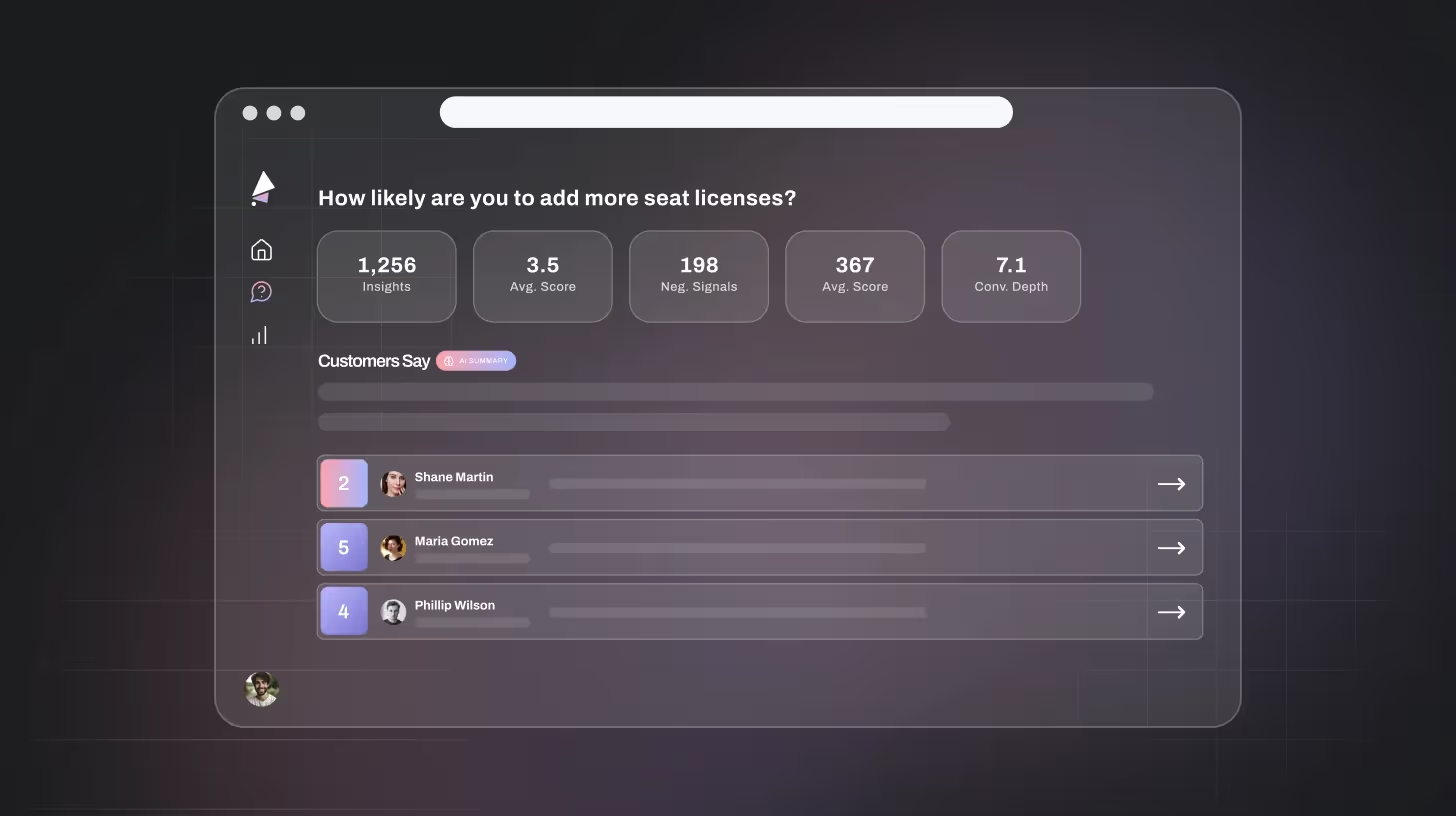
Creating surveys with AI has become faster and more efficient. AI-powered survey tools like Theysaid allow users to create surveys in seconds tailored to their target audience, eliminating the complexities of traditional survey methods.
- One of the best features is conversational AI, which provides detailed survey insights by exploring the why behind the feedback.
- AI-moderated interviews enable conducting interviews at scale while capturing deep, qualitative data.
- TheySaid also provides automated survey analysis, summarizing trends and identifying actionable items effortlessly. This allows companies to adapt strategies promptly and efficiently, staying ahead of shifting markets and client demands.
How AI Has Overcome the Flaws of Traditional Market Research Surveys
Traditional online surveys, while effective in their own right, have limitations that hinder their ability to provide in-depth insights. However, AI has overcome those flaws and changed how market research surveys are conducted and analyzed.
Automated Survey Creation
Traditional survey methods require businesses to manually create questions that take time and effort, and still fail to capture the insights. With AI-powered tools like TheySaid, companies can create surveys with a single click, personalized to their target audience, making it a faster and more efficient way.
Enhanced Engagement and Response Rates
Getting people to complete a survey is always a challenge. Traditional surveys are long, tedious, and provide a limited scope. AI-powered surveys create more engaging experiences through natural language processing and conversational features that make the survey feel like a conversation, not a form.
In-Depth Data Analysis
Traditional surveys fail to understand the why behind responses, leaving businesses with limited data. AI excels at processing qualitative and quantitative data. With advanced machine learning algorithms, it uncovers complex patterns and provides rich insights.
Scalable Insights Across Industries
AI-powered surveys are flexible and scalable across industries. Whether in healthcare, retail, financial services, or technology, businesses can collect high-quality insights from a larger audience without compromising accuracy.
Sign up for free today and see how TheySaid can transform your market research!
FAQs
What is the difference between market and marketing research?
Market research targets collecting data about consumer behaviors and market trends from a market, while marketing research is concerned with investigating the effectiveness and efficiency of marketing activities.
What are the common mistakes to avoid when creating a market research survey?
Some common mistakes to avoid while creating a market research survey are:
- Using leading and double-barreled questions
- Lengthy survey
- Neglecting clear objectives
- Ambiguous questions
- Asking the wrong audience
- Forcing respondents to answer
- Choosing the wrong distribution method
- Using the wrong market research techniques
Can AI help with survey analysis?
Yes, AI tools like TheySaid can quickly analyze responses, identify trends, and provide actionable insights.
What are the different types of market research surveys?
The main types of market research surveys include: Customer Satisfaction Surveys (CSAT), Brand Awareness Surveys, User Persona Surveys, Market Segmentation Surveys, Product Market Fit Surveys (PMF), Competitor Analysis Surveys, Customer Effort Score (CES) Surveys, and Net Promoter Score (NPS) Surveys.
How do I choose the right market research survey for my business?
Start by defining your survey goals clearly:
• Choose CSAT to measure customer satisfaction.
• Choose a brand awareness survey to measure familiarity with your brand.
• Choose a competitor analysis survey to understand your market position.
• Choose PMF to evaluate how well your product meets market needs.
What are the benefits of using AI-powered market research surveys?
AI-powered survey tools like TheySaid offer: automated survey creation for personalized questions, enhanced engagement with conversational features, and in-depth data analysis using machine learning to uncover complex patterns and actionable insights.






.svg)


